• Leash Reactivity

    We describe a dog as being “leash reactive” when they bark, lunge or growl at specific triggers that they see while on leash. Possible triggers for this behavior include dogs, cats, people, bikes, and wild animals. Modifying this behavior is possible but requires a high level of consistency.

    Necessary Supplies:

    • A treat pouch
    • An abundance of high-value treats (tiny portions of hot dogs, cheese, etc.) 
    • A 4 to 6-foot leash (no retractable leashes)
    • A comfortable, properly-fitted harness 
    • A waist leash for added security (optional)
    • A squeeze tube for added ease of treat delivery (optional) 

    Step One: Management

    It is important to set up a management plan for our leash-reactive dogs so that we can help them be as successful as possible. Remember, other dog owners will not be aware of the spatial needs of your dog, so you will have to be a “defensive driver” on their behalf. Keep an eye out for other dogs and avoid them at the beginning of your training journey. Walk your dog in open spaces where you can easily see approaching dogs and can turn and walk in the opposite direction if needed. This may mean that walks in busy neighborhoods won’t be possible in the beginning, and that’s OK! 

    You may choose to not walk your dog unless you’re in a training session and provide them physical and mental exercise other ways. This could include playing fetch in a fenced-in yard or on a long line in a dog-free space, taking your dog to an indoor pool to swim (remember to give the facility a heads up that you’ll need a dog-free path to the enclosed pool), or increasing mental enrichment inside with treat dispensing toys (see Enriching Your Dog’s Life Handout for more ideas).

    Step Two: Counter-conditioning 

    You will want to begin your counter-conditioning protocol well outside of your dog’s threshold. Your dog’s threshold is the distance at which they begin to react to their trigger and are unable to take food. We want to start far enough away from the trigger that they can see it but are unlikely to have a reaction. The moment your dog sees the trigger, before they react, begin to feed them. Be sure that they see the trigger FIRST and begin to feed them second. The food should be constant with little to no pause in between each piece. You should continue to feed them until their trigger goes out of sight or until you move them further away from the trigger. This food can be fed directly from your hand or scattered on the ground. Some dogs are more successful with one versus the other, so you can try both and assess which works best for you. 

    Finding an appropriate training location is critical. Be sure to consider spaces where your dog will see other dogs but won’t be approached by them. This might be a pet store or vet clinic parking lot. If your dog is very reactive, you may even choose to stay in your car for the first few training sessions so that if your dog is struggling, you can simply drive away. Eventually, parks with large, open spaces can be great training locations. These spaces give you the ability to stay far away from dogs and give you the room to avoid a dog directly approaching you.

    Step Three: Look at That 

    Once your dog is showing relaxed body language and eating readily with step two, you can move on to playing “Look at That.” This is a training game that works similarly to step two, but allows the dog to look at the trigger for a longer period of time. Remember, your end goal is for your dog to be calm and non-reactive when they see their trigger(s), so we need to teach them that they can feel relaxed when they acknowledge the presence of those things. 

    Be sure to have a treat pouch full of high value treats, just as you would for step two. The moment that your dog looks at the trigger, say “yes!” in a bright, happy voice, put a treat in front of their face, and use it as a lure to turn their head away as they lick and chew on the piece of food. When their head is no longer facing the trigger, release the rest of the treat for them to eat. Be prepared: they will immediately look back at the trigger after you release the food into their mouth. The moment they look at the trigger, say “yes!”, put a treat in front of their face, and turn their head away as they lick the treat. Again, when their head is no longer facing the trigger, release the rest of the treat for them to eat. 

    This is a rapid-fire game that requires you to pay careful attention to your dog. You will continue to say “yes!” the moment that they look at the trigger, turn their head and feed them over and over again, until the trigger disappears or until you guide your dog further away. 

    Progressing with these skills: 

    It is important to be patient and work slowly with your dog while modifying their leash reactivity. Your goal will be to work slowly and thoughtfully enough that they do not feel the need to react (remember, we want to build relaxation in the presence of their triggers and setting them up to react is counter-productive). At each distance, be sure that your dog is relaxed and that the work is easy for them. When you see that your dog is comfortable and confident, you can move closer. Be sure that you only move closer to the trigger by a few feet at a time and that you are assessing their comfort at each distance. If your dog becomes stressed or reactive at a distance, you need to move further away. It may be many weeks or months before your dog has the skillset to work in close proximity to other dogs while on leash. 

    A note about training treats: 

    This work requires a HIGH level of reinforcement, particularly in the beginning. This means that we must be very thoughtful about when we train and for how long. Keep your sessions short and look for high-value treats that your dog tolerates well. Some dogs can eat hot dog after hot dog without issue, others will need boiled chicken to keep their digestive tracts healthy and happy. You should NEVER take your reactive dog out into the world without your high value training treats. If you are hoping to keep the quantity of treats lower during a session, be sure to take your dog to a space where you are very unlikely to encounter their triggers. 

    Remember, this is HARD work

    This work is incredibly difficult for our reactive dogs. This means that you will need to keep sessions short and give them “off” days. Instead of walking them in spaces where you will encounter their triggers, occasionally stay at home. You can offer enrichment and work on training exercises in the house rather than going on a “training walk.” You can also seek out spaces that you can rent privately to give your dog the chance to explore, sniff, and exercise without the added stress of encountering their triggers. Keep in mind that they will be mentally tired after working in the presence of their triggers; offer them chances to decompress, like working on a frozen, stuffed KONG. 

    Be kind to yourself

    It is absolutely OK (and necessary!) to give yourself breaks, as well. If you don’t feel that you have the energy to support your dog in the presence of their triggers, skip the walk and support your dog with other forms of exercise and enrichment. 

    If you get surprised by another dog while on your walk, practice a U-Turn. This is a quick turn in the opposite direction. This should be a game for your dog that you have practiced in calm situations so when you need it, it will be automatic.

    Teach a U-Turn:

    • In a happy tone say, “U-Turn!” and quickly pivot around 180 degrees, patting your leg to encourage your dog to follow you. 
    • After you have jogged 10-15 feet away from the other dog, reward your dog with a small treat. 

    It is important that you practice this exercise when there are not dogs around. Then when the time comes and you are surprised by a dog, you can quickly “U-Turn” and get out of the situation.

    YouTube video
  • How to Reduce Jumping

    When dogs jump up on people, it can be more than a nuisance behavior, it can be dangerous. Large dogs can knock people down, causing injury, especially in children and the elderly. Many puppies learn at a young age that jumping on humans is acceptable. However, when the dog gets older, they will continue to jump on people. If you can, start teaching them to keep all four paws on the floor during puppyhood. However, if your adult dog jumps on you or guests, have no fear; it is still possible to change that behavior! 

    Think of teaching “four on the floor” as a basic exercise. Before your dog begins jumping, reward them with a tasty treat. Pay close attention to where you are placing your treat hand. If you raise your hand too high, you will accidentally encourage your dog to jump. The treat should be delivered at the dog’s lower jaw or tossed on the floor. 

    Understanding how dogs learn and what motivates their behavior is key. Often people respond to a jumping dog with verbal attention, petting, or even rough pushing. For most dogs, this is reinforcing the behavior. The dog thinks that jumping earns them what they want: your attention! We want to teach our dogs they can get our attention, treats, and petting when they have four paws on the floor. If they jump, they lose access to these rewards. 

    Teaching Four on the Floor

    When your dog jumps on you, cross your arms and turn your body away from them. When they have four feet on the floor, reward them with petting, attention, and/or treats. Treats should be something your dog considers high-value, like boiled chicken or hot dogs. These treats should be cut into pea-sized pieces so your dog does not consume too much. Over time, your dog will learn that jumping does not get them what they want. It is important for everyone in the household, including visitors, to consistently ignore the jumping and reward them whenever they are keeping all four paws on the floor. If your dog continues to jump on you even when you ignore them and becomes increasingly excited, remove yourself from the situation. Leave your dog alone for 30 seconds to a minute and try again. You may have to repeat removing yourself a few times. See Inappropriate Play Handout and/or Mouthing Handout.

    Teach Your Dog to Sit for Greetings 

    It is helpful to teach your dog to sit for all greetings and interactions. You can teach your dog that sitting is extremely rewarding by giving them treats, playtime, or other valuable resources. By reinforcing “sit” with treats, attention, or other rewards, your dog will learn to do it as an automatic response when greeting and interacting with you, rather than jumping up to say hello. 

    Practice When Guests Come Over

    Set your dog up for success by managing interactions with people. If you are having guests over, give them an enrichment item and keep them in a crate or in another room behind a baby gate until the excitement of the guest’s arrival has passed. You can also keep them on a leash and reinforce sitting while the guest approaches and offers attention if they desire. Tell your guests what you are working on. Have them practice by rewarding the dog with treats and giving attention when your dog is sitting or has four on the floor. Ideally, everyone your dog encounters should be consistent with this training. 

    Other Management Tips 

    Keep treats in a garage,  car, or main entry way and toss multiple treats on the ground as you enter. When you and your dog are out and about, always have treats on-hand. If your dog becomes excited and starts to jump, toss treats on the ground to keep the dog’s focus on eating the treats and not jumping. This can be a great distraction for your dog if a surprise situation arises and causes excitement. 

    Keep your arrival home low-key. If your dog is crate trained or in a separate area of the home, do not rush in to greet them enthusiastically. Instead, calmly acknowledge them and take a few minutes to bring in your bag, read the mail, etc. Even if it has been a long day, keep your energy low and take your dog outside to relieve themselves. The more you practice these tips, the quicker your dog will learn that your arrival home is not that exciting. 

    Provide your dog with plenty of physical exercise. When your dog has expelled energy constructively, perhaps by playing a strenuous game of fetch, they will be more relaxed and comfortable. 

    Provide your dog with mental enrichment items. Give your dog a stuffed Kong, treat, meal dispensing toy, and plenty of appropriate items to keep their brain busy and relieve stress. Have your dog’s favorite enrichment item ready when guests visit. (See exercise and enrichment handout).

    Take your dog to Manners Classes. The Wisconsin Humane Society offers a variety of classes. 

  • Hot Weather Safety

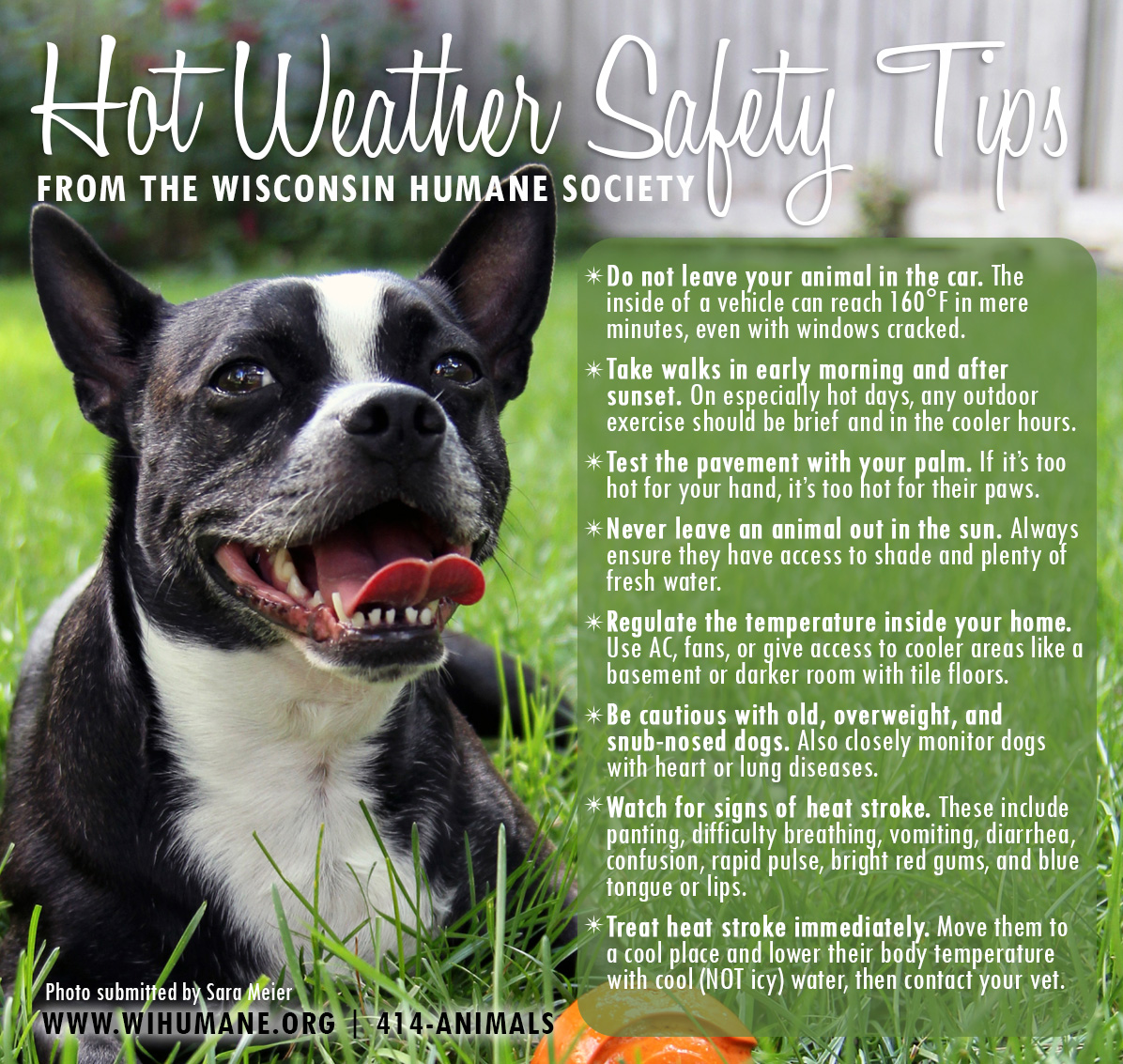
    Please take every precaution available to keep your pets cool as temperatures often soar in Wisconsin in the summer. Here are a few tips from the Wisconsin Humane Society to keep your pets safe in the extreme heat.  

    • Never leave an animal alone in a vehicle, because overheating can kill him. The inside of a vehicle can reach 160 degrees in mere minutes, even with the windows cracked.
    • Take walks in early morning or after sunset. On especially hot days, any outdoor exercise should be brief and in the cooler hours.
    • Test the pavement with your palm. If it’s too hot for your hand, it’s too hot for their paws.
    • Never leave an animal out in the sun. Always ensure they have access to shade and plenty of fresh water.
    • Regulate the temperature inside your home. Use AC, fans, or give access to cooler areas like a basement or darker room with tile floors.
    • Take extra precautions for old, overweight or snub-nosed dogs in hot weather. Boston terriers, Pekingese, Pugs, Lhasa Apsos, Shih Tzus and Bulldogs are especially vulnerable. Dogs with heart or lung diseases should be closely monitored.
    • Watch for signs of heat stroke. These include panting, difficulty breathing, vomiting, diarrhea, confusion, rapid pulse, bright red gums, and blue tongue or lips.
    • Treat heat stroke immediately. Move them to a cool place and lower their body temperature with cold water, then contact your veterinarian.
  • Heartworm Disease FAQs

    Thanks to the American Heartworm Society for much of this information.

    What is Heartworm disease?

    Heartworm disease is a serious and potentially fatal disease in pets in the United States and many other parts of the world.  It is caused by foot-long worms that live in the heart, lungs, and associated blood vessels, causing severe lung disease, heart failure, and other organ damage with time.  Heartworm disease affects dogs, cats, ferrets, and some wild animals such as wolves, coyotes, and fox.  Wild animals are considered important carriers of the disease. 

    The dog is the natural host for heartworms, which means the parasite can mature to adults and produce offspring to continue the life cycle.  Cats are atypical hosts and the heartworms usually do not survive to the adult stage, however there can still be severe health effects.

    How is Heartworm transmitted from one pet to another?

    The mosquito plays an essential role in the heartworm life cycle.  Adult female heartworms living inside a dog, coyote, wolf, or fox produce microscopic offspring called microfilaria that circulate in the bloodstream.  When a mosquito bites and takes a blood meal from an infected animal it picks up the microfilaria, which mature into an “infective stage” larva inside the mosquito over a period of 10-14 days.  Then, when the infected mosquito bites another dog, cat, or susceptible wild animal, the infective larvae are deposited into that animal.  These larvae then go on to become adult heartworms in approximately 6 months.   Once mature, heartworms can live for 5-7 years in dogs and 2-3 years in cats.  Because of the longevity of these worms, each mosquito season can lead to an increasing number of worms in an infected animal.

    What are the signs of Heartworm disease in dogs?

     In early stages of the disease, many dogs show few or no symptoms at all.  The longer the infection persists, the more likely symptoms will develop.  Active dogs, dogs heavily infected with heartworms, or those with other health problems often show pronounced clinical signs.

    Signs of heartworm disease may include a mild persistent cough, reluctance to exercise, fatigue after moderate activity, decreased appetite, and weight loss.  As heartworm disease progresses, pets may develop heart failure and the appearance of a swollen belly due to excess fluid in the abdomen. 

    The adult heartworms cause inflammation of the blood vessels and can block blood flow leading to pulmonary thrombosis (clots in the lungs) and heart failure.  Heartworm disease can also lead to liver or kidney failure.  Large numbers of worms can cause sudden blockages of blood flow within the heart leading to a life-threatening cardiovascular collapse.  This is marked by a sudden onset of labored breathing, pale gums, and dark bloody or coffee-colored urine.  Prompt surgical removal of the blockage is needed or the dog will not likely survive.

    When should my dog be tested for Heartworm? Is it preventable?

    Heartworm disease is a serious, progressive disease, so the earlier it is detected the better the chances for recovery.  The test requires just a small blood sample from your pet and it works by detecting the presence of heartworm proteins.

     Puppies under 7 months of age can be started on heartworm preventative without a heartworm test, since it takes 6 months after infection for a dog to test positive.  The puppy should then be tested 6 months after the initial visit and again 6 months later.  After that, testing should be yearly.

    Dogs over 7 months of age and previously not on preventative need to be tested prior to starting heartworm prevention.  They also need to be tested 6 months after the initial visit and again 6 months later.  After that, testing should be yearly.

    Dogs over 7 months and who have been on preventative should have yearly heartworm tests.

    Annual testing is necessary, even when dogs are on a heartworm preventative medication.  These medications are highly effective, but dogs can still become infected, especially if you miss one dose or give it late. Dogs can also unknowingly spit out the oral medication or rub off the topical medication.

    What happens if my dog tests positive for Heartworm?

    Restrict exercise.  Your dog’s normal physical activity must be restricted as soon as the diagnosis is confirmed, because physical exertion increases the rate at which the heartworm causes damage to the heart and lungs.  The more severe the symptoms, the less activity your dog should have.

    Stabilize your dog’s disease.  Before actual heartworm treatment can begin, your dog’s condition needs to be stabilized.  Dogs with serious disease will need some time to stabilize. 

    Administer treatment.  Begin treatment using the American Heartworm Society’s guidelines.  This will take several months and includes microfilaricides, Doxycycline, and adulticide injections.  There may be other medications, depending on the severity of the disease. 

    Test to determine success of treatment. Approximately 6 months after the end of treatment you should have a heartworm test done to make sure the worms have been cleared.  You must wait this long because worm particles may take a long time to clear and these particles will give a positive test.

    How successful is the treatment for Heartworm?

    Dogs with no signs or mild signs of heartworm disease, such as cough or exercise intolerance, have a high success rate with treatment.  More severe disease can also be successfully treated, but the possibility of complications is greater.  Success also depends on the dog’s activity level during treatment.  If exercise is not restricted, it can lead to more complications.  Dogs who are older or have other health problems may be compromised already and not do as well with treatment.

  • Dog Enrichment

    Like us humans, our dogs need both physical exercise and mental enrichment on a daily basis. Lacking either one, dogs can resort to undesirable behaviors. By giving our dogs an opportunity to use their natural instincts, you can improve both their environment and quality of life. Here are a few recommendations to get you started:

    Indoor dog pools 

    Many cities have businesses that offer indoor, heated dog pools. Swimming is a great form of exercise and these spaces allow you to stay inside (and warm!) while a staff person helps your dog to safely acclimate to the pool. Eventually, once they can confidently and safely swim, you can also seek out safe outdoor swimming places for your dog, as well. 

    Secure, fenced-in spaces 

    It is important to give your pup the occasional opportunity to stretch their legs off-leash. These spaces should be securely fenced and should not necessarily be dog parks. Some dogs can jump surprisingly high, so we would recommend using a secure, back-clip harness and long line the first time your dog explores these spaces. That way, if your dog does surprise you and jump over the fence, they are unable to run away. Ask a neighbor if you can use their secure, fenced-in yard to let your pup have a romp, or search online for local businesses who have spaces available to rent for individual dog use. Be sure to pack poop bags, a water bowl, a few favorite toys, and enjoy! 

    Treat-dispensing/puzzle toys 

    These interactive toys are filled with food and require your dog to engage with them to make the toy dispense the food. They are a great way to get your dog’s brain working by challenging them to solve the puzzle. There are a variety of treat-dispensing toys available and they range in level of difficulty. When first introducing your dog to these toys, start with an easy option and build up to the more challenging toys over time. You may need to help your dog figure out what to do with the toys at first. An example of an easier toy is the Kong Wobbler, versus a more challenging dispensing toy such as the Tug-a-Jug which requires more dynamic movements from the dog. Search online and you will find endless options for treat-dispensing and puzzle toys. You can also create your own enrichment toys using everyday household items: 

    • Muffin tin – Take a standard muffin tin and place treats in each divot. Then place a tennis ball on top. Your dog will then have to sniff around the tin and knock the tennis balls off to get the treats out. Have a small dog? Try a mini-muffin tin and mini tennis balls. 
    • Cardboard box/tube – Take a cardboard box or tube (paper towel or toilet paper tube) and place several treats inside. Close up the box or scrunch the ends of the tube shut. Allow your dog to tear apart the cardboard to get the treats out. This will create a bit of a mess, but the easy cleanup will be worth your dog’s enjoyment. With bigger boxes, you can add additional treats or a toy for the dog to find. Be sure to remove any tape or plastic labels on cardboard boxes prior to giving them to your dog. 

    Treat-dispensing/puzzle toys not only provide your dog with mental enrichment but can also be given in place of food bowls or as an activity while you are away. Consider feeding your dog their meals in a treat dispensing toy. This will keep them occupied longer while they engage with the toy for their meal, and gets both their body and their brain working. It is a great way to provide your dog enrichment in the mornings before work while you are getting ready. 

    You can also leave your dog with an enrichment item to provide mental exercise while you are away. When doing this, make sure the enrichment item is not a choking hazard. As one example, a Kong can be filled with different types of food your dog enjoys (like peanut butter and kibble) then frozen. When you are getting ready to leave, give your dog the frozen Kong. Freezing it will make it more challenging and will keep your dog engaged longer. 

    Long-term chews as enrichment 

    Dogs love to chew! You can offer your pup marrow bones, raw bones, bully sticks, frozen Kongs, and many other options to keep them busy and mentally stimulated. When introducing any new treat, make sure your dog is supervised, and be sure to check with your veterinarian first. Worried about your pup’s sensitive stomach? Soak his regular kibble in water, add a tablespoon full of something exciting (plain yogurt, canned dog food, boiled chicken), mix well, use that concoction to fill their Kong (or any other puzzle toy), then freeze before serving.

    Designated Digging 

    Digging is another natural behavior for dogs, but is frequently discouraged and unwanted by humans. If you dog enjoys digging, providing them an appropriate place to dig will give them an outlet for that natural desire and provide mental and physical exercise. Create a designated digging area by using a sandbox, kiddie pool, or by building your own. Encourage digging by burying their toys in the box for them to dig up. When beginning this process, make the toys easy to find for your dog. Over time, increase the depth at which the toys are buried. You can begin to use “digging” as a cue over time, thereby training your dog to “go dig” when the time is appropriate.

    Nose work 

    Dogs possess up to 300 million olfactory receptors in their noses, compared to the mere six million we have. In addition, the part of the dog’s brain that is devoted to analyzing smells is, proportionally speaking, 40 times greater than ours! Therefore, utilizing a dog’s sense of smell is another great way to engage their brain and enrich their lives. 

    • Snuffle mat – The snuffle mat consists of fleece strips tied on to a rubber mat with holes in it. The loose ends of the fleece are on top and provide hiding spots for the treats. This is similar to treat-dispensing toys, as it can be used for feeding meals, but it requires the dog to actively use their nose to hunt out the treats. This is another item that can be purchased or made at home. You can also use the grass outside as a natural snuffle mat; drop treats in the grass and allow your dog to sniff around for the yummy morsels.
    • Decompression walks – Dogs love to explore their environment, but walks on concrete without any opportunity to sniff are not particularly exciting for our dogs. While appropriate leash-walking skills are important, we should also be sure to give them the opportunity to sniff, mark, and enjoy the smells that their daily walks offer them. Want to give your dog a truly exciting experience? Purchase a long lead from your local pet store, take your dog to a quiet park or field and let them explore while you hold onto their lead. Be sure that you do this in a space where they will not be able to reach the road, strangers, other dogs, or otherwise endanger themselves. Fifteen-to-twenty feet of long line to run, explore, sniff, and practice coming when called will go a long way toward wearing out your high-energy dog. To prevent injury, be sure that if your dog is on a long line, it is attached to a secure, back-clip harness and NOT to a collar. See Decompression Walk Handout
    • Nose work games – There are many nose work games you can play with your dog that require very little training or experience. Check out the link below which will provide instructions on some basic games and how to play them with your dog.

    Check out a local Canine Nose Work class for a higher level of difficulty for both you and your dog.

    Training Classes

    Our dogs are incredibly intelligent and love to learn new skills and behaviors. Positive reinforcement group training classes can be a great way to increase your ability to communicate effectively with your dog. The more behaviors your dog understands, the easier it will be for you to redirect unwanted behaviors and ask for more desirable ones. CLICK HERE to sign up for a class offered by our behavior experts at the Milwaukee and Ozaukee Campuses.

    Finding creative ways to enrich your dog’s life is beneficial for both you and your pup, with the added benefit of building a positive relationship between you and your companion. If you have additional questions regarding dog enrichment or dog behavior, contact the Wisconsin Humane Society behavior department at behavior@wihumane.org or 414-431-6173.

  • Dog Shopping List

    The biggest mistake that proud new dog parents make is coming home not fully prepared. Here is a list of common items that most dogs need when transitioning into their new home. Some dogs may require more items than this for support, while others may need less. Talk to your adoption counselor about specific items that will benefit your dog. 

    Food and Water Dish:

    Food and water dishes are not all created equally.  Avoid plastic food and water dishes since they are highly porous and easily scratched making them a bacteria magnet. They lack durability ESPECIALLY with a teething puppy! Ceramic dishes are great if they are coated in a lead-free glaze. Make sure there are no chips or cracks since this can allow for a higher risk of your dog ingesting part of the ceramic. Stainless steel bowls are typically the best option since they are non-porous and much easier to clean. 

    Food:

     Many people don’t think about what they want to feed their dog before bringing them home. It is important to understand that dog foods come in a large variety and you want to be careful with what you choose. Dog food that is on the cheap end typically does not contain enough nutrients for dogs causing pet owners to spend a lot more money at the vet. A safe rule of thumb is to know that higher quality dog food is typically found in pet stores rather than in big box stores. Many pet stores have dog food organized by quality as well, making it easier to find exactly what you want. Remember, when first bringing home your dog to have some of the food they are used to transition them to the food you would like them to be on. Without a transition period they are more likely to suffer from digestive upset. 

    Chew Toys:

    The sensation of chewing is something very enjoyable to most dogs. Without hard toys to chew on most dogs turn to household items to alleviate there need to chew. Having your dog chew your furniture legs or favorite pair of shoes can be rough on your new relationship. Nylabones and Kongs are the most common items pet owners choose to help their dogs with this sensation. 

    Hard and Soft Toys:

    It’s no secret that dogs need daily enrichment to stay healthy. Having a variety of toys will help to alleviate boredom and be mentally and physically stimulating to your pet. A variety of toys will help to peak your dog’s interest and give him options once one loses its excitement. Tennis balls, stuffed toys with squeakers, and rope toys are great choices for a brand-new pet. The variety of textures, noises, and shapes will be very stimulating to your pet. Be careful with leaving toys out all the time, since the dogs become use to them and the toys can then lose their exciting spark. 

    Crate:

    Crating your dog should always be a positive experience. Therefore, a crate should never be used as a punishment method and should be of proper size. A dog should be able to stand up, sit down, and turn around easily in a crate. If a crate is too small, it should not be used with the dog since it can cause a lot of stress on the animal and is inhumane. When first training a dog to use a crate only have her in there for short amount of times such as 15 minutes, then 30 minutes, and so on. Place toys in the crate for the dog to interact with. A dog should not be left crated for longer than 8 hours and not all dogs do okay with long periods of crating. For more information about crating see our page on crating

    Enzymatic Cleaner:

    Chances are your new pet will have at least one accident in your home. It is important to consider what you are using to clean up your pet’s accident. Enzyme cleaners are best to use since they break down the urine and neutralize the odor, so your pet does not continue to relieve themselves in the same spot. We recommend using Simple Solution for any accidents. 

    Leash and Collar:

    Most towns have leash laws requiring your animal to be on a leash when outside. A leash gives you control over your dog and where they go. A collar allows for ID tags, Rabies tags, and licensing tags to be displayed while having a clip for the leash to be connected to. Make sure your collar is fitted properly on your dog. A simple rule of thumb is to have just enough space to slip two fingers between the collar and dog’s neck. A collar that is too tight can cause suffocation or irritation on the dog. For more information on leashes, collars, and walking your dog please see our page on loose leash walking

    Grooming Supplies:

    Grooming your dog is a great bonding experience for you both. Grooming promotes healthy blood circulation and a healthy coat. If you have concerns over grooming your dog groomers are available to help. Shampoo, brush, and a nail trimmer are the most common household items to have. 

    Training Treats:

    When you first bring your dog home, you both will have a lot to learn about each other. Training will be essential to start with right away. Positive reinforcement training is known for being one of the most effective training methods. Treats should be bite size and very tasty to be most effective. 

    Poop bags:

    It is the law to pick up your dog’s waste. When waste isn’t picked up it can transmit parasites or diseases to other animals. It can also kill grass and get into ground water. Not picking up your dog’s waste is also bad manners to your fellow neighbors. Make sure to have some with you when going for walks or at the park. 

    Flea and Tick Preventative:

    Fleas and ticks can cause many issues. Fleas can carry tapeworm and some ticks can carry Lymes Disease. Talk to your vet about flea and tick preventatives right away to ensure that your dog stays clear of these nasty parasites!

  • Dealing with Dog Obesity

    Obesity is an extremely common problem in dogs and, as with humans, can be detrimental to their health. Many guardians think their pudgy dogs are adorable, when in fact they are very unhealthy. The overweight dog has many added stresses upon his body has an increased risk of developing diabetes, liver problems and joint pain.

    • Obesity develops when energy intake exceeds energy requirements. The excess energy is then stored as fat. Once a dog is obese, he may remain obese even after excessive caloric intake stops. The majority of cases of obesity are related to simply overfeeding, coupled with lack of exercise.
    • Certain groups of dogs appear more prone to obesity than others. Specific breeds (Labrador Retrievers and Pugs, for example) and older dogs are particularly prone.
    • Is your dog a hog? As a subjective assessment of body condition, you should be able to feel the backbone and the ribs in an animal of healthy weight. If you cannot feel your dog’s ribs without pressing, there is too much fat.
    • Also, you should see a noticeable “waist” between the back of the rib cage and the hips when looking at your dog from above. Viewed from the side, there should be a “tuck” in the tummy—the abdomen should go up from the bottom of the rib cage to inside the thighs. Dogs who fail these simple tests may be overweight.

    Consult your dog’s veterinarian before starting on a weight loss program, which should include these major areas:

    Correct Diet: Overweight animals consume more calories than they require. Work with your veterinarian to determine your dog’s caloric requirements, select a suitable food and calculate how much to feed. The diet should contain a normal level of a moderately fermentable fiber and the type of fat that prevents the skin and coat from deteriorating during weight loss. Diets that dilute calories with high fiber lead to increased stool volumes, frequent urges to defecate and variable decreases in nutrient digestibility.

    Treats: We all love to give our dogs treats. However, treats should be given in moderation and should represent five percent or less of the dog’s daily food intake. The rest should come from a nutritionally complete dog food. When using treats frequently, such as during training exercises, try to use the smallest pieces you can.

    Exercise: Increasing physical activity can be a valuable contributor to both weight loss and maintenance. Regular exercise burns more calories, reduces appetite, changes body composition and will increase your dog’s resting metabolic rate.

    Guardian Behavior Modification: A successful weight management program requires permanent changes in the behaviors that have allowed the dog to become overweight. Perhaps you are giving your dog too many treats, for example, or not giving him enough opportunities to exercise.

    Are you committed to your dog’s weight loss? Here are some important things you can do:

    • Remove your dog from the room when the family eats.
    • Feed your dog several small meals throughout the day.
    • Feed all meals and treats in the dog’s bowl, in an enrichment toy, or during training.
    • Provide non-food related attention.
    Information provided by the Wisconsin Humane Society and The American Society for the Prevention of Cruelty to Animals (ASPCA). All Rights Reserved. Copyright © 2009.
  • Common Health Problems

    Fleas

    Fleas tend to be more of a seasonal concern being the most prevalent in the summer and early fall

    Often the first time you might notice fleas is when they bite you and your family, so watch closely for the symptoms of fleas on your dog and use protective measures to prevent them.

    The warning sign of fleas are excessive biting, scratching, and rubbing by your companion animal, small but visible fast-moving brownish-black bugs, multiple skin irritations caused by the flea bites and noticeable “flea dirts;” these are the small black feces of the flea.

    To test for fleas moisten a sheet of white paper and hold it under your dog. Briskly comb the dog’s fur. Any “flea dirt” which falls onto the paper will produce a visible red bloodstain.

    To prevent fleas keep your dog away from unfamiliar animals, especially wild animals. Vacuum and clean the carpet, furniture, and the dog’s bedding repeatedly to remove fleas and eggs. Fleas on your dog can be controlled with many different treatments available from your vet. All animals in the home must be treated for fleas as well. Ask your vet for the best way to treat your home and yard for fleas.


    Ear Mites

    Ear mites are insects that are too small to see with the naked eye. If the condition goes untreated, ear mites may cause a secondary infection that must also be treated. Ear mites are transmitted by direct contact between your pet and another infected animal, so be sure to keep your dog away from other animals that have ear mites. Symptoms are the vigorous shaking, scratching, or rubbing of the affected ear and a thick black crust formed in the ear canal of the animal.

    If you suspect your dog may have ear mites, it is advised that you have your veterinarian check your dog’s ears. Your veterinarian can recommend the appropriate treatment since many forms of treatment can be effective. The pet should be immediately isolated from other animals until completion of the treatment.


    Kennel Cough

    Kennel cough is a highly contagious viral disease, especially for dogs, which are closely confined, under a lot of stress or in the cold or drafts. See your veterinarian to make sure your dog is vaccinated against kennel cough, especially is your dog will be in close contact with other dogs as kennel cough requires direct contact with an infected dog to be spread.

    Symptoms first appear five to ten days after the dog has been infected. Kennel cough is characterized by harsh, dry coughing which may be followed by gagging and retching. This is sometimes accompanied by sneezing and a clear watery discharge from the nose. Although the cough is described as “dry” it is common for dogs to cough up varying amounts of saliva and mucus. Kennel cough may cause a secondary infection, which will produce a fever, loss of appetite and depression.

    In most cases of healthy dogs, the viral disease runs its course in 10 to 12 days. Any secondary infection should be treated with an antibiotic from your veterinarian. A healthy dog will get over kennel cough; much like a human gets over the common cold. Kennel cough can, however, be fatal to puppies, aged or debilitated dogs. Humans cannot catch kennel cough. If the cough does not subside in 21 days, contact your veterinarian.


    Otitis

    Otitis occurs when moisture collects in the ear canal resulting in decreased air circulation, inflammation, and eventually infection. Factors contributing to Otitis include excess hair in the ear canal, a history of allergies, floppy ears or wet ears. Typically you will notice your pet scratching at his ears or shaking his head. Additionally a strong odor about the face or ears may be detected as well as redness in the ears or an increase of wax in the canal. If severe or left untreated, the infection can result in rupture of the eardrum, excessive growth of the tissues of the ear canal, and even deafness. To prevent Otitis it is helpful to remove excess hair from the ear canal. This can be done by a groomer, veterinarian or by the guardian if properly trained. For dogs with floppy ears it is important to clean the ears every two to three months. Dogs that are in the water frequently should have their ears dried by swabbing with a dry cotton ball. If you notice any redness, discharge, or foul odor of the ears it is important to contact your veterinarian for proper care and treatment of your pet’s ears.


    Heartworm

    Heartworm is a blood parasite that can be transmitted to dogs through a mosquito bite. After a six-month incubation period, the adult worms, which can reach a length of 11 inches, can be found in the heart and main blood vessels to the lungs. This can cause severe respiratory signs, heart failure, and death. Treatment is available and is successful in most cases but does present certain risks. Luckily, heartworm disease is preventable! Monthly medications are available that will prevent heartworm but it is important to have your veterinarian blood test your dog, since a heartworm positive dog should not be started on the preventative medication. Preventative medication is usually given in the months that mosquitoes are more prevalent, typically April through November. Due to milder winters in the recent years some veterinarians may advise to give heartworm preventatives all year long. Please talk to your veterinarian about the prevention of this serious disease.


    Parvovirus

    Often called “Parvo,” parvovirus, is contagious to dogs only-not to cats or people. Signs include vomiting, fever, and bloody diarrhea with a very foul odor. The younger the dog, the greater the chance it will NOT recover.

    The virus may attack the heart muscle causing inflammation of the heart muscle. Dogs with canine parvovirus infection shed massive amounts of virus in the feces. Parvovirus is transmitted through the feces of an infected dog. It can be carried on dog’s hair and feet as well as live on contaminated rugs, bedding, shoes, and other objects. An effective cleaning disinfectant is 4 ounces of bleach in one gallon of water.   

    Dogs remain highly susceptible to parvo until two weeks after the last injection of the immunization series. Death from parvo may result from dehydration, overwhelming bacterial infection from the pet’s lowered resistance, blood loss from internal hemorrhage or possible heart attack from invasion of the heart muscle by the virus.

    In parvovirus, the pet often becomes “dehydrated” from the vomiting, diarrhea, and inability to consume fluids. Life is NOT possible when 12-15% of the normal body fluids are lost. This is the reason fluid therapy is so important in treating parvovirus. Treatment is aimed at maintaining the normal body composition and preventing secondary bacterial infection. We have no cure for any animal virus, just as there is no cure for any human virus.


    Whenever you suspect an illness, infection or virus of your dog, please contact your veterinarian.

  • Bringing Your Dog to Picnics & Outdoor Events

    To bring or not to bring the dog… that is the question.

    Outdoor parties and picnics are a great way to spend time with family and friends, breathe in the fresh air and enjoy some great food, but what about Max? Does he have to stay home alone all day while you are out socializing? With a little planning, Max can enjoy this year’s picnic season, too. These tips should help you enjoy summer’s festivities with your best buddy.

    First, be sure the location of the picnic is dog-friendly and follow all posted rules. Some parks have picnic sites that allow dogs, while others do not.

    If you are not the person in charge, be sure to check with your host or organizer that bringing your canine companion is acceptable. If held at someone’s home, ask in advance, not with dog in hand

    Bring appropriate supplies, which include:

    • Leash Food and water bowls
    • Dog bed or towel
    • Long line or tie out
    • Chew toys or enrichment toys
    • Healthy dog treats (cooked hot dog, cooked chicken or string cheese cut into tiny treats the size of your pinky finger nail)
    • Tennis ball, Frisbee or other retrieving toy

    When you arrive at the picnic site, tend to your dog first; you can socialize later. Select an area that provides shade and is away from the food preparation and cooking stations. No matter how easygoing a party is, no one likes a begging dog or food thief. Once you have selected a site, lay down your dog’s bed or blanket and scatter a few treats and toys on the blanket. Fill your dog’s water dish and secure the tie out. Allow your dog to explore the “doggy area” on his tie out. Stay close. Do not abandon your dog at the doggy area.

    On leash, start to introduce your dog to the guests. Have high value treats and reward your dog for walking well on leash and sitting for petting. If there are guests who are leery, do not force your dog on them. It could be a bad experience for both the guests and your dog.  

    When the guests start eating, keep your dog in the doggy area and feed him tasty treats in his bowl, or provide him with an enrichment toy, like a stuffed Kong or Tricky Treat Ball. Now it is time to play. Using his favorite toys, engage him in games of fetch, catch or chase. It is best to keep your dog on a long line and let him drag it behind so you can quickly and easily grab control of the leash if necessary.

    You know your dog best. If he is not very social with people or other dogs at home, chances are he is not going to be very social in a new and stressful environment. In this case, you may be better off leaving him at home.

    Beware of picnic scraps like bones, corn cobs and other things dogs could choke on. Pick up all trash and debris immediately.

    Do time-outs. If your dog is getting overstimulated, calm him down in his doggy area; or take him on another walk through the woods to expel his energy.

    Be prepared to leave early. Certain dogs do not do well at picnics. If your dog becomes way too obnoxious or anxious, perhaps you better take him home. Don’t let him spoil everyone else’s fun. Likewise, if there are other dogs that make you or your dog uncomfortable, keep your dog’s safety a priority and take her home.  

    Always be a good steward and pick up after your dog.

    NEVER put a dog in a warm car. The temperature can sky rocket in minutes and could be fatal.

  • Bringing Home a Fearful Dog

    Dogs are individuals with unique experiences and behaviors. Just like us, one dog may react differently than another dog to a novel experience. When bringing home a dog who shows fearful behaviors, you need to learn your dog’s body language and what causes them to become fearful. Dogs can be fearful of almost anything, including but not limited to people, noises, sights, smells, movement, or environments. There are several common reasons why a dog is fearful, though we rarely know what caused that fear in the first place. Even if we don’t know the cause of the fear, we are still able to modify the behavior and help our dogs feel more comfortable. 

    Most commonly, a dog’s fear stems from a lack of exposure, a scary experience in the past, or a genetic predisposition. A dog who has had limited experiences in their life are likely to be fearful when encountering something new, such as traffic or visitors. Likewise, a dog who had a negative experience with a particular human or object, may be fearful of similar people or items in the future. Genetics also play a role in fearful behaviors in dogs. Just like people, dogs can be genetically predisposed to fearful behaviors or other challenges. Some dogs will remain cautious and uncomfortable with triggers throughout their lives, while others will show more confidence and adapt to a new home life with support from their family. It is important to be prepared for both situations when working with a dog who shows fearful behaviors. 

    With this in mind, there are several ways to set your dog up for success and help them feel comfortable when coming into your home. 

    Setting your dog up in a safe space and allowing decompression time:

    Set your dog up in a single room that is low-traffic and quiet. Provide the dog with food, water, toys, and a crate with a bed. The door to the room should be closed, or the doorway blocked by a baby gate. Have this room ready for your new dog prior to their arrival for an easy transition. If your dog is so fearful that they are not comfortable with going outside on a leash for potty breaks or you are unable to touch the dog, place potty pads in their room. This allows your dog to eliminate without the stress of being handled or clipped to a leash when they are uncomfortable. Allow your dog time to become comfortable in this single room before introducing them to the rest of the home.  

    Every dog needs a period of time to decompress and get back to baseline relaxation when in a new home. The amount of time required can vary with each dog. At a minimum, expect it to take a full week. 

    During this time, it is important to provide your dog with a quiet environment and limit the amount of new people and experiences they have. Do not invite visitors over to meet the dog, have a large gathering, or take your dog on outings to novel locations such as pet stores or dog parks. 

    Slow and appropriate interactions with members of the household:

    Giving dogs choices, especially fearful dogs, creates a more confident dog and decreases stress over time. When a dog knows they have a choice and the ability to move away from what is making them uncomfortable, it gives them more power in the situation and reduces their stress level. This means the dog should always be given the choice to interact with someone or something. Finding something your dog finds reinforcing will be very helpful moving forward. Food is a common reinforcer for dogs and is easiest to work with. You may have to experiment with several different treats to find what your dog likes. Many dogs like hot dogs, chicken, or cheese, though all should be distributed in tiny pieces and in moderation.

    When beginning to interact with your dog, start by walking past the room and tossing a small handful of treats (cut small to roughly the size of a pea) over the baby gate blocking the doorway. You can also sit in the room with your dog tossing treats in their general direction. Remain on the opposite side of the room from your dog, always allowing them space to move away. Do not try to coax your dog over to take treats from your hand. Sometimes, a dog will choose to approach for a high value treat because the food item is highly reinforcing. When approaching you for the treat, the dog might realize how close they are to the “scary” person and then feel trapped or over their fear threshold. This may cause them to escalate to a growl or bite. To avoid this situation, continue tossing treats away from you, allowing the dog to approach you once they choose to, instead of just for treats. When they begin to approach you, continue to toss treats away to reinforce them and allow the dog to choose to approach again. Once your dog is approaching you readily and soliciting attention, you can offer petting under the chin or on the chest. Avoid any fast movements or reaching over their head, as those can both come across as threatening. Follow the 3-second rule with petting. If the dog solicits petting, pet them for 3 seconds, then pause and wait for the dog to re-initiate the petting (this may look like them pawing at you, nudging your hand, or leaning closer to you). If they do, pet them again for 3 seconds and repeat. This allows the dog to continue to have a choice during the interaction. It may take days or even weeks for your dog to choose to approach and solicit attention. It is important to go slowly and not rush the process. Going too slowly will not cause harm, however rushing the process could cause your dog more stress and fear. If at any point your dog is showing forward-moving aggression, stop what you are doing and contact a professional for help.  

    Remember that once your dog is comfortable with you and your family, they are likely to still be fearful of new people. They are also likely to show fearful behaviors in new situations, even if they are comfortable in your home. It will be important for you to be your dog’s advocate by setting up their environments for positive and safe interactions. Set clear guidelines with visitors on acceptable behaviors around your dog prior to visits. If your dog is uncomfortable, do not allow people to approach, pet, or attempt to interact. You can remove your dog from the environment and place them in a separate space with a high value enrichment item to avoid unwanted interactions.  

    Introducing your dog to new people, objects, and environments

    When you begin to introduce your dog to new people, novel objects, or environments, there are several techniques you can use. Two recommended methods are called “Counter Conditioning and Desensitization” and “Treat and Retreat.” Follow the links below for more details on these two methods. 

    It is important to continue supporting your dog and working with their fearful behaviors so it does not escalate. Modifying fearful behaviors can be difficult and it is helpful to work with a professional one-on-one who can support you and your dog through the process. When working with a professional, ensure they are a positive reinforcement trainer prior to beginning the behavior modification process.

    Contact the Wisconsin Humane Society behavior department at behavior@wihumane.org or 414-431-6173 with additional questions.