• Barrier Reactivity

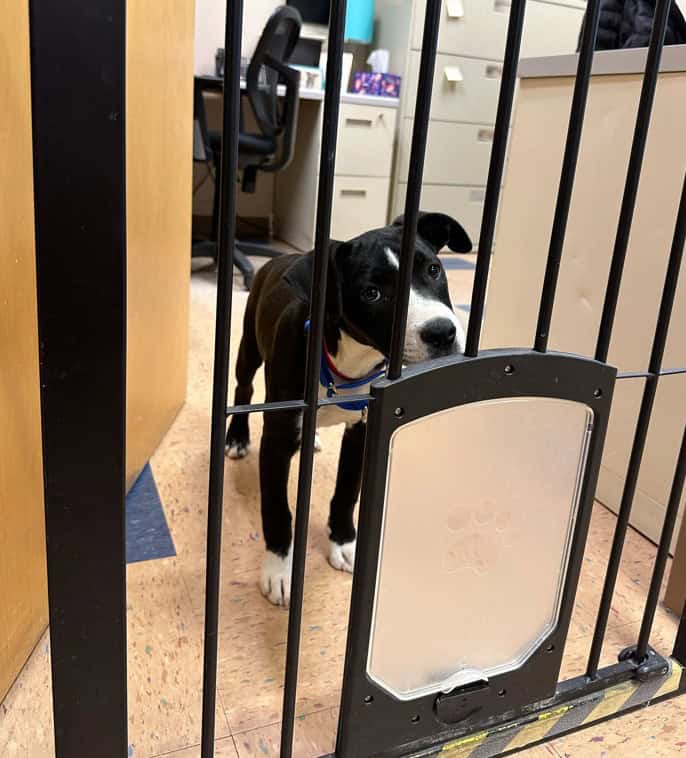
    We refer to a dog as being “barrier reactive” when they bark, growl, or rush forward in response to a stimulus when they are behind a barrier. The barrier may be a fence, baby gate, window, screen door, car window, or any other physical item that stands between them and the stimulus. The trigger for this behavior might be another dog, cat, person, or squirrel, just to name a few. Modifying this behavior is possible, but requires lots of consistency.

    Step One: Management

    It is important to have a management plan in place before you attempt to modify this behavior. You will need to cover windows and/or any breaks in the fence line to ensure that your dog is unable to see through them, attempting to eliminate their need to react in the first place. You may also want to keep your dog’s leash clipped to their collar, but let them drag the handle so you are able to grab it and safely redirect them if they do become reactive. 

    Step Two: Training

    Once your management plan is in place, you can begin to work towards modifying this behavior. Be sure you are always present when your dog has access to the barriers they’re reactive to; this may mean restricting access to certain rooms or areas when you aren’t home. Cut up tiny pieces of high value food, like hot dogs or bits of their favorite smelly treats, and approach the barrier with your dog on leash. Remove the covering so they can now see through the window or fence line. The moment that they notice the trigger, begin to feed them constantly. Feed them for 10-30 seconds, put the visual barrier back in place, and stop feeding them.

    If your dog begins to bark or react and is too distracted to take the food, don’t panic! That simply means that your dog is over their threshold. Your dog’s threshold will be the physical distance at which they will no longer take food because they are too focused on the trigger. If your dog is over threshold, you will be unable to modify their behavior in that moment. It will be necessary to move them further away from the trigger and possibly remove them from the situation altogether. If you find that being up close to the barrier is too difficult for your dog, move further away and try again once they have had the chance to calm down.

    Be sure to keep these sessions short! This work is difficult for our dogs and you will want to train for a few very short sessions (1-3 minutes each) per day when you begin, rather than working for longer periods of time.  As this work becomes easier for your dog, you can work with them for longer and longer periods of time.  

    Top Tip:

    Buy several airtight treat jars, fill them with non-perishable treats, and place them throughout your home. This will give you the opportunity to quickly offer your dog reinforcers throughout the day for staying relaxed when they hear their triggers, and for coming to you when called.

    YouTube video
  • Barking: Causes and Solutions

    Barking is a normal part of dog behavior. In excess, though, it can become bothersome. Below are a few of the reasons why dogs bark and what you can do to address them. 

    Discomfort with Confinement

    If your dog is not used to being confined in a crate, pen, or bedroom, or has had negative experiences while confined, it can lead to anxiety and increased barking as a result. If you believe that this may be the root of their barking, consult our crate training information for additional support. 

    Separation Anxiety

    Your dog may be experiencing separation anxiety if they bark most when you leave the house, appear to be frantic when you return, and/or are destructive when you are away but not when you are present. It’s important to recognize that this reaction is an expression of their panic and not something to become angry or upset about. WHS offers resources on working through separation anxiety; you may also find it beneficial to contact a Certified Professional Dog Trainer who practices positive reinforcement for assistance in creating a behavior modification plan.

    Arousal/Frustration

    We often see dogs who bark at windows or fence lines at passing people, cars, or other dogs. It’s important to manage the environment so these dogs do not have the opportunity to practice this behavior. Create a visual barrier so your dogs can only see through it at the time of your choosing. You can also choose to limit their access to the windows that they regularly react at by blocking off those rooms with baby gates, or having your dog on a tie line in the yard so they cannot reach the fence line. The only time that your dog should have the ability to look through the barriers is when they are on leash and you are prepared for a training session with them. From a distance, remove your visual barrier and wait until their trigger (a person, car, animal, etc.) is present, then feed them a series of high-value treats. Continue to feed until the trigger goes away. Once the trigger is gone, you can either wait for the next one or replace the visual barrier. You will need to continue with this protocol for many sessions until your dog’s level of comfort increases. At that point, you can slowly begin to lengthen your sessions and increase the amount of time between individual pieces of food. This process requires a great deal of patience, consistency, and attention to detail – you may benefit from the support of a Certified Professional Dog Trainer who practices positive reinforcement for assistance. You can learn more by consulting our resources on barrier reactivity.  

    Fear

    Barking out of fear is a normal way for a frightened dog to ask the trigger to “go away!” When a dog is barking because they’re scared (perhaps of a new person, another dog, or a foreign object), it’s important not to force them to interact with it. Barking, in this instance, is a symptom of a bigger issue. Instead, either respect the request and give them more space, or work to help them feel more comfortable from a distance with that trigger. The easiest way to reduce their fear is to feed them high-value treats in the presence of that scary item so they start building positive associations. If the scary thing is a human, the treats should come from someone the dog is comfortable with and at a good distance from the trigger person. If that is not possible, the “scary” stranger can toss food to the dog from a distance, ideally with a barrier between them. If at any point the behavior intensifies, take that as a clear sign that your dog is too close to the thing that they are afraid of and move them further away. Be sure to keep training sessions short and successful, giving your dog frequent breaks. For more information, consult our fearful dog resources.

    Demand Barking

    Dogs will sometimes bark for attention or because they want something you have. This is one of the few types of barking that you might accidentally reinforce without realizing it. If your dog is staring at you and barking while you have food in your hands and you give them a piece, you have reinforced that behavior and are making it more likely to happen again. Similarly, if they’re barking to get your attention and that’s when you get up and take them for a walk or toss a toy, they’re learning that barking is an effective way to initiate fun. Instead, the moment that your dog demand-barks at you, stand up and walk away. Do not talk to, scold, touch, or otherwise interact with your dog in these moments. You are merely communicating that the moment they bark at you, they lose access to you. You can come back after a few seconds. You may need to do this dozens of times before your dog starts to understand. Keep an eye out for alternative behaviors that you should reinforce if your dog is a chronic demand-barker. If your dog quietly sits in front of you while you have food on you, give them a treat and praise them! Teach them that there are other, quieter, ways to ask for what they would like rather than barking at you. 

    The importance of meeting your dog’s basic needs:

    Our dogs will be more inclined to bark excessively if they are bored or haven’t gotten enough exercise. Be sure that you are providing daily mental and physical enrichment so they are less inclined to bark overall. Helpful tips and tricks for providing mental and physical exercise can be found in our dog enrichment resources.

    What NOT to do: 

    We do not recommend using bark collars of any type (nor any other type of punishment) in an attempt to reduce barking. While they may decrease the barking in the moment, they do not address the underlying issue and will only increase anxiety and the likelihood of destructive behaviors.

  • Toxic Household Products

    Adapted from the American Animal Hospital Association

    As a pet owner, you want to keep your furry friend safe and healthy, but their curious nature can occasionally get them into trouble. Animals investigate the world with their mouths, and they can ingest poisonous substances accidentally. 

    Pets and Medications

    Even medication that does not require a prescription can be extremely dangerous to your pet. Nonsteroidal anti-inflammatories such as ibuprofen and naproxen can cause acute kidney failure and should never be given to pets. Do not try to treat a pet’s medical problem at home without consulting a veterinarian, and never give them medication that is not approved for veterinary use.

    Prescription animal medications often are flavored to increase palatability, so pets may mistake them for treats and eat more than prescribed. Inquisitive pets may even eat pills that aren’t flavored, so keep all medications out of reach. Remember, animals can chew through plastic bottles, so child-proof may not mean pet-proof.

    What foods are toxic to pets?

    Many foods that are safe for people can be deadly to pets and this is not a comprehensive list. Keep the following toxic/dangerous foods away from your dog:

    • Avocado seed
    • Alcohol
    • Caffeinated drinks
    • Cooked bones
    • Chocolate
    • Garlic
    • Grapes and raisins
    • Macadamia nuts
    • Onions
    • Raw yeast dough
    • Xylitol (often found in sugar-free gum and some peanut butter)

    Never leave food where your pet can reach it, and keep pets out of the kitchen when children are eating to prevent them from gobbling up dropped morsels.

    What other household items are dangerous to my pet?

    Products such as paint, glue, and cleaning chemicals often are left out on the assumption that pets won’t eat these bad-smelling/bad-tasting substances, but it’s not worth the risk. Some pets lap up liquids because they have an interesting texture or feel good on the tongue. Household products can contain dangerous chemicals and some glues expand in the stomach, causing a life-threatening blockage.

    Ant baits, bug sprays, and foggers can also be poisonous to your pet. Read labels to ensure proper use of these products and prevent pets from exposure during and after use. Store all insecticides on high shelves out of a pet’s reach.

    Products designed to kill rodents are particularly dangerous to pets, as they may be tempted to eat the tasty bricks, granules, or pellets left out for mice and rats. Rodenticides kill rodents by causing internal bleeding, high calcium levels, brain swelling, or toxic gas production. Never put rat bait out where your pet can find it and keep your pet confined to your yard to prevent him from eating your neighbors’ rodenticides. Find safe, humane solutions to wildlife conflicts by visiting www.wihumane.org/wildlife

    Plants Toxic to Pets

    Plants found in flower beds, vegetable gardens, and indoor planters or arrangements can be toxic to pets. Cats – who particularly like to munch on greenery – are sensitive to many plant types, but dogs can also be at risk. A complete list of toxic and non-toxic plants can be found on ASPCA’s website, but the most common toxic plants include:

    • Aloe
    • Autumn crocus
    • Azalea
    • Begonia
    • Boxwood
    • Burning Bush
    • Creeping Charlie
    • Cyclamen
    • Daffodils
    • Hyacinth
    • Hosta
    • Hydrangeas
    • Kalanchoe
    • Lily of the Valley
    • Lilies
    • Oleander
    • Sage palm
    • Tulips 

    If your pet eats leaves, flowers, or stems, immediately take them and a plant sample to your veterinarian. Although toxicity signs may not be apparent, it is vital to remove poisonous material as soon as possible to prevent toxin absorption in the body.

    Many products used on lawns, gardens, and flower beds can cause toxicity in pets. Fertilizers made from bone or blood meal are tempting to pets and can cause pancreatitis if ingested, or can clump in the intestines or stomach, causing a blockage. Other fertilizers and herbicides applied to lawns also may contain toxic chemicals.

    The American Society for the Prevention of Cruelty to Animals (ASPCA) Animal Poison Control Center is open 24 hours a day, 365 days a year, to advise pet owners about potential pet toxicities. If you think your pet may have ingested a potentially poisonous substance, call (888) 426-4435. A consultation fee may apply.

  • Pet Obesity

    Unfortunately, most pet owners are not aware of this growing problem.  Your veterinarian can help you distinguish whether or not your pet is at his or her ideal body weight.  If it is determined that you pet is overweight, your veterinarian can discuss an appropriate diet for your pet, including the type and amount of food and the frequency of feedings.   He or she can also help tailor an appropriate exercise plan for your individual pet, taking into account any medical conditions, breed, and age.

    All pet owners should strive to maintain an ideal body weight for their pet.  Obese dogs and cats are more likely to suffer from osteoarthritis, type 2 diabetes, high blood pressure, heart and respiratory disease, amongst many other issues.   Most concerning is that being overweight can greatly decrease an animal’s life expectancy.  By working with your veterinarian, you can help your pets stay at a healthy weight and can help ensure that they lead a long and healthy life.

  • Introducing Dogs to People Using a Barrier

    Introducing Dogs to People Using a Barrier

    A barrier is an invaluable tool to set your dog up for success when being introduced to people. It allows your dog to see and smell visitors without the pressure of a physical interaction. It provides a visual reminder for those who may not understand that your dog needs more space to feel comfortable. A barrier can also be beneficial for dogs who get overexcited and aroused when people enter the home.

    Set Yourself & Your Dog Up for Success

    Prior to visitors arriving, review the Dog Body Language Handout so you can successfully monitor your dog’s comfort level and stress signals. Purchase high-value treats that are easily accessible to have on hand for yourself and your guests to use throughout the interaction. Before visitors enter your home, place your dog behind a barrier. The barrier needs to be tall and secure so your dog cannot jump over it, go through it, or get around it. Be sure to have a backup plan in the event your dog is unable to recover or settle in the presence of visitors. This may include having a spare room, crate, or other area to put your dog where they can be completely separated from your visitors with a high-value enrichment item, such as a peanut-butter-filled Kong. 

    Set Up Your Visitors

    Prepare your visitors before they arrive by letting them know what behaviors your dog may display and what your expectations are of the visitor when they arrive. Instruct them to ignore your dog completely which includes not walking toward them, not talking to them, not staring at them or facing them directly, and not reaching over the barrier. There should be no attempt to engage with your dog at all until you direct them to. Ask your visitors to contact you before they enter your home so you can place your dog behind the barrier and prepare yourself.

    Fearful Dogs

    With dogs who are fearful it is especially important to remember that visitors should be instructed to simply ignore your dog and toss high value treats from a distance. If/when your dog begins to show relaxed, neutral body language, the barrier can be removed. Attaching a leash to your dog’s collar and allowing it to drag along the floor once the barrier is removed can be a helpful tool for you to calmly guide them back behind the barrier or into another safe space away from visitors if they become uncomfortable.

    When the barrier is removed, visitors should continue tossing treats especially if they are changing their location (ex. standing up to move into a different room). They need to be mindful of their own body language, minimize quick movements, and refrain from loud vocalizations or sounds. When beginning to interact with your fearful dog, they should always toss food away from themselves and allow the dog to choose to re-approach when they are ready. They should not try to coax the dog over with the food. If the dog approaches the visitor repeatedly with a soft and loose body, the visitor can offer pets under the chin or on the chest.

    If your dog continues to react by barking, growling, retreating, showing tense body language, or not accepting food while behind the barrier, do not remove it. Instead, put your dog in a separate room or ask your visitors to leave. These behaviors are an indication that your dog is very stressed, overwhelmed, and should not be around visitors at this time. We recommend reaching out to a behavior professional for additional support before attempting future introductions.

    Active/Aroused Dogs

    When dogs become overly excited or aroused when guests come over, it is still important to instruct your guests to completely ignore your dog. Eye contact, talking to the dog, or any other engagement with the dog may increase excitement and arousal. Treats can be tossed on the floor to help promote relaxation and orient your dog to keeping four paws on the floor. Allow visitors to enter the home and settle in before attempting to remove the barrier and allowing your dog out to greet them. 

    Once your visitors are equipped with high-value treats and your dog is showing relaxed, calm body language, you may remove the barrier. Attaching a leash to your dog’s collar and allowing it to drag along the floor once the barrier is removed can be a helpful tool for you to calmly guide them back behind the barrier or into another safe space away from visitors if they become uncomfortable. 

    Instruct your visitors to drop handfuls of treats on the floor as the dog approaches to set the dog up to successfully keep four paws on the floor when greeting the visitor. Continue to reward for desirable behavior (four paws on the floor, offering a sit, etc.), and provide them with toys and enrichment items to settle with. If your dog becomes too excited and aroused when the barrier is removed, calmly put them back behind the barrier or in a different room with a high-value enrichment item. 

    Additional Resources

  • Safe Haven

    Safe Haven

    Safe Haven Foster Program

    Currently available through our Milwaukee Campus

    The Wisconsin Humane Society Milwaukee Campus and Sojourner Family Peace Center have partnered to provide the Safe Haven program, which offers up to 60 days of shelter for animals from families affected by domestic violence.

    Research finds that 75% of abused women who have companion animals report a history of their companion animal being threatened or intentionally harmed by their intimate partner*. Abusers often use animals as pawns to manipulate and control the survivor, taking advantage of the survivor’s concern for his or her animal. Abusers may threaten, harm, or kill animals to intimidate survivors, demand silence about the abuse, or prevent them from leaving.

    Many survivors are unable to leave an abusive situation because they fear for their animal’s safety. The Safe Haven program makes it possible for survivors to leave an abusive relationship without losing their companion animal. Animals provide companionship, comfort, and unconditional love to survivors and their children affected by domestic violence, and preserving the bond between families and their animals is vitally important.

    I need help. How do I get support?

    • Milwaukee area residents: to enroll in the Safe Haven program, contact the Sojourner Family Peace Center at 414-933-2722
    • Residents outside of Milwaukee: click here to find resources available near you

    I want to help. How can I support the Safe Haven Program?

    • Volunteer as a foster parent – Opening your home to an animal through the Safe Haven program not only provides a comfortable home environment for the animal, but also peace of mind for their family. Your generosity will help save lives – both human and animal. Find more information and apply here. 
    • Donate! You can make a contribution exclusively for Safe Haven here

    “Our friend Joe Pabst has been a driving force in our ability to offer this important program, and we’re so appreciative for his partnership. This program is one of the many ways we are able fulfill our mission of making a difference for animals AND the people who love them. We are grateful to the Sojourner Peace Center to help accomplish that, by offering families in these unthinkable situations a safe place for their pets while they find safety themselves.” -Alison Fotsch, WHS President & CEO

    “I come from a family who love animals. One of my sisters was a victim of domestic violence and I believe that her pets were an obstacle in her ability to leave. They were very important to her.  Despite our efforts and many interventions, we couldn’t save her. In the people the Safe Haven Foster Program helps, I see my sister. I see a survivor. I see a person with another chance.” -Joseph Pabst


    *McDonald, S. E., Collins, E. A., Maternick, A., Nicotera, N., Graham-Bermann, S., Ascione, F. R., & Williams, J. H. (2019). Intimate Partner Violence Survivors’ Reports of Their Children’s Exposure to Companion Animal Maltreatment: A Qualitative Study. Journal of Interpersonal Violence, 34(13), 2627-2652. https://doi.org/10.1177/0886260516689775 

  • Dangers of Puppy Mills

    Dangers of Puppy Mills

    Puppy mills are breeding facilities that produce puppies without concern for their physical, social or emotional needs. The puppies are sold to the public via the internet or newspaper ads, or to brokers and pet shops across the country. Unsuspecting consumers often obtain puppy mill puppies facing an array of immediate veterinary problems, or harboring genetic diseases that do not appear until years later. Such medical problems can be a financial hardship on the dog’s family.

    Animals originally from puppy mills and other unscrupulous breeders are sometimes surrendered to the Wisconsin Humane Society because they are sick or have serious behavior problems. 

    Many dogs from puppy mills are inbred or overbred, and receive minimal veterinary care, poor quality food and water, and very little socialization. Sadly, some dogs are forced to live in puppy mills for their entire lives. Female dogs are sometimes killed or sold once their reproductive years are over. 

    Most pet stores obtain their dogs from puppy mills. There is one way to end that cycle: don’t support businesses that sell animals, and don’t obtain animals from these sources.

    In an unprecedented move, the Wisconsin Humane Society bought and shut down the state’s largest breeding facility, Puppy Haven Kennel, in 2008. WHS worked to find homes for more than 1,600 dogs from Puppy Haven. These dogs had never had their own beds, toys, or even names. Most were terrified of people and cowered when someone approached. WHS staff worked to rehabilitate the dogs and provided adopters with information about the special social and physical needs of puppy mill dogs.

    On December 1, 2009, Governor Doyle signed Wisconsin Act 90 into law. This important piece of legislation will establish a much-needed licensing and inspection program to end the suffering of thousands of dogs at the hands of unscrupulous dog breeders.

    This legislation ensures that breeders provide minimum standards of care for dogs and levels the playing field for reputable breeders who already provide for their dogs. Click here for information about selecting a reputable breeder.

    This legislation also regulates animal care at shelters. The Wisconsin Humane Society provides care and treatment above and beyond the standards set forth in the legislation. WHS will continue to comply with such legislation and subsequent rules, and we are happy to be included because we know that regulation will ultimately result in better care for animals everywhere.

  • Adopting Two Puppies at Once

    Adopting Two Puppies at Once

    Why experts warn against adopting two puppies at the same time and what you can do for your dogs if you did take home two at once.

    CONTENT FROM WHOLE DOG JOURNAL ARTICLE BY PAT MILLER, CPDT, EDITOR OF WHOLE DOG JOURNAL


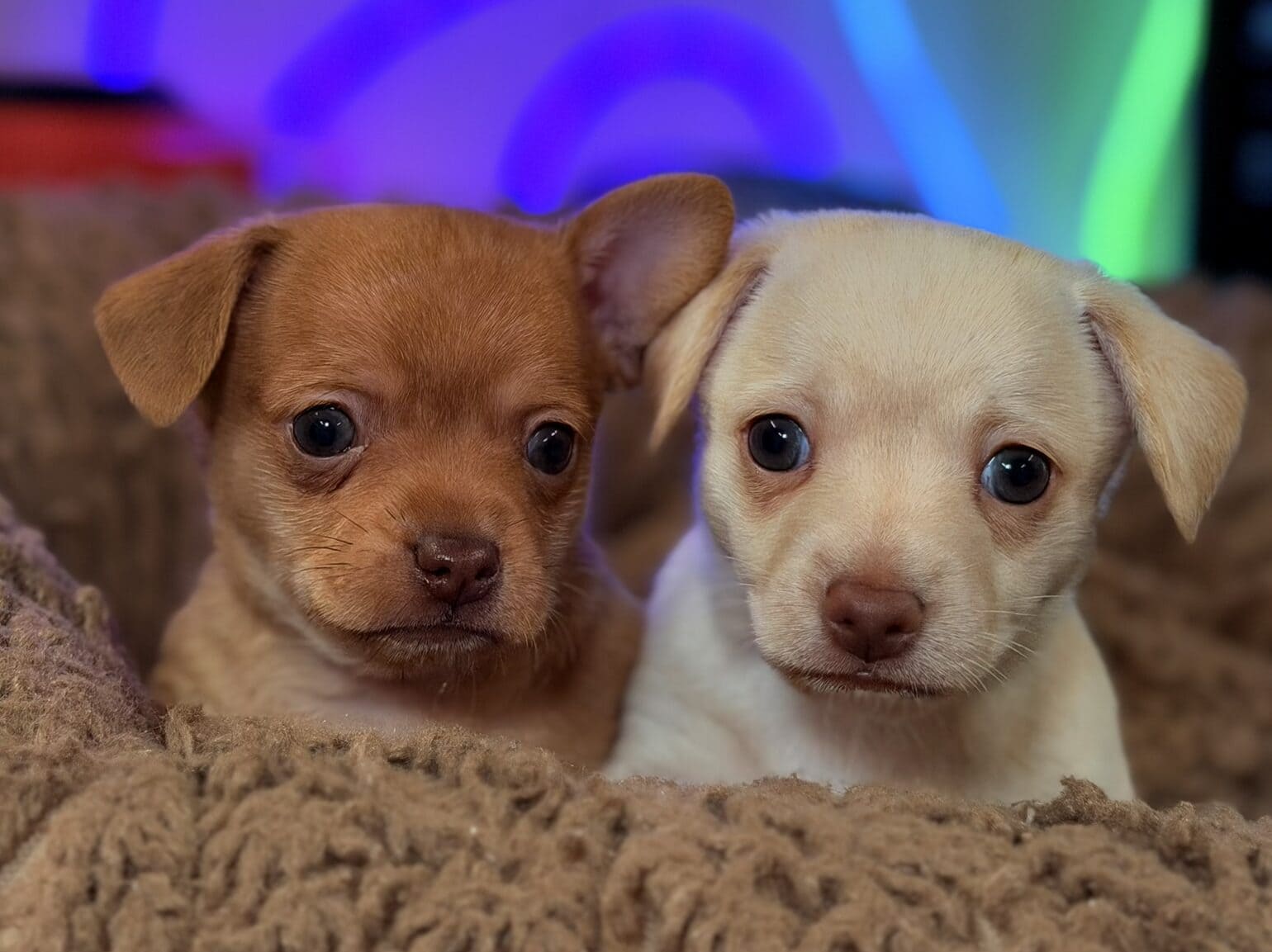
    There’s no denying it: a new puppy is one of the world’s most wonderful things. It’s a cold, hard heart that doesn’t get all mushy over puppy breath, soft pink puppy pads, and the fun of helping a baby dog discover his new world. So, if one puppy is wonderful, two puppies must be twice as wonderful, right? Well, not usually.

    Most training professionals strongly recommend against adopting two pups at the same time. The biggest challenge of adopting puppy pairs is their tendency to bond very closely with each other, often to the exclusion of a meaningful relationship with their humans. They can become inseparable. Also, owners often underestimate the time commitment required to properly care for and train two puppies; as a result, the pups often end up untrained and under-socialized.

    Don’t do it

    There are very good reasons to think long and hard about not getting two puppies at once, whether they are siblings or not. While the majority of new puppy owners seem to recognize that one puppy is enough of a responsibility for them, a certain number fall prey to one of a few common arguments about why two puppies might be better than one. Let’s take a look at the most common reasons that people say they want to adopt two puppies at the same time – and why they shouldn’t be considered.

    Two-pup rationale #1: “I want to get two puppies so they will have someone to play with while I’m gone all day at work.”

    It’s a good thing to recognize that your pup could use companionship during the day. However, if you think one puppy can get into trouble when you’re not there, just think what kinds of mischief two pups can cook up when left to their own devices. Better solutions might include:

    • Adopt your new pup at a time when someone in your family can take a week (or several) off work to stay home and help the puppy adjust gradually to being left alone. A couple of weeks vacation time? Kids home for the summer? Just be sure to use the time wisely, so your pup can learn to happily accept being alone when it’s time to go back to work or school.
    • Find a friend, neighbor, or relative who is home much of the time and who is willing to provide daycare for your pup – and experience the joys of having a puppy to play with during the day, without the long-term responsibilities and costs of having a dog for 15-plus years.
    • Ask your vet if she has another client with a similar-age puppy and see if the two of you can mingle your pups at one of your puppy-proofed homes for puppy daycare, and send the second baby dog back home after work. Note the emphasis on “puppy-proofed.” Two pups can still get into a heap of trouble, even if one of them isn’t yours.

    Two-pup rationale #2: “I have two children and they each want their own puppy.”

    What a sweet idea. Just say no. Since when do the kids get to make the rules? Most families have enough trouble getting their kids to fulfill their promise to feed, walk, and clean up after one family dog. Mom ends up doing most of it anyway. So now Mom gets to do double-puppy-duty? If there’s a compelling reason for them each to have a dog, consider adopting one puppy now, and an adult dog from a shelter or rescue group. Even then, adopt one first and give her at least a month to settle in, if not longer, before adopting the second.

    Two-pup rationale #3: “We want to have two dogs eventually anyway, so we might as well get them at the same time so they can grow up together as best friends.”

    Well, that’s what you might well get! When you raise two puppies together, they usually do grow up to be inseparable best friends, often to the detriment of the dog-human relationship. Inevitably they spend far more time together than they do individually with you, with a likely result that they become very tightly bonded to each other and you are only secondary in their lives. Many owners of adopted-at-the-same-time puppies ultimately find themselves disappointed in their relationships with their dogs, even when they are committed to keeping them for life.

    This super-bonding also causes tremendous stress (and stress-related behavior problems) on those occasions when the dogs do have to be separated – and sooner or later, something will come up that requires them to be separated: one goes to training class and the other doesn’t, you want to walk one but not both, or a health-related problem requires one to be hospitalized or otherwise kept separate.

    Two-pup rationale #4: “A second puppy will play with the first and keep her occupied when I’m too busy to spend time with her.”

    Nice thought, but here’s a heads-up: if you’re too busy to give one puppy the time she needs, you’re definitely too busy for two puppies!

    There are great interactive dog toys on the market that can help occupy your pup when you can’t play with her – and don’t think that either another puppy or a pen full of toys can substitute for social time with you. Puppies do take time, and it’s important you give that some serious thought before adding a baby dog to the family. It’s fine to give her playmate-time via arranged play dates with a friend’s healthy and compatible puppy, but don’t think adopting a second pup is an acceptable substitute for your own interaction with your puppy.

    Two-pup rationale #5: “If we adopt a second puppy, that’s one fewer that might be euthanized.”

    I won’t argue with this, except to say that in many shelters around the country today, puppies aren’t the problem. Of course there are exceptions, but I’d say the majority of shelters in the United States now have no problems placing most if not all the puppies they get. It’s the adult dogs who are most likely to die because of homelessness. If you really want to save a life, adopt a grown-up dog instead of a puppy, or at least adopt your puppy now, and come back for an adult dog in a few months.

    Two-pup rationale #6: “The breeder we are buying our puppy from thinks it’s best if we take two.”

    If you’re buying from a breeder who encourages you to purchase two puppies at once, run away fast. A truly responsible breeder will, in most cases, refuse to sell two puppies to one home, except on the rare occasion that a prospective buyer can prove she has the skill, knowledge, time, ability, and monetary resources to provide an excellent environment for two pups at once. Someone who tries to push two puppies on a buyer isn’t a very responsible breeder, and isn’t doing her puppies, or the new owner, any favors.

    What to do if you adopt two?

    Perhaps you’ve already adopted two puppies and are ruefully regretting your error. Or maybe you don’t regret it, but you realize you’ve taken on far more of a responsibility than you realized. Perhaps you’re determined to go ahead and do it anyway, despite my advice above. If you do take the bait and find yourself in double trouble, there are things you can do to minimize problems and maximize your success as the owner of a puppy pair:

    • Crate them separately. Your pups are going to have plenty of together time; they don’t need to sleep together too. You can certainly leave them together in their puppy-proofed space when you’re gone all day, but they should be crated separately at night. You can crate them near each other, but this is the perfect time to start habituating them to not always being in close contact with their sibling. When they are comfortable in their crates close to each other, you can gradually increase distance between crates until they can be crated out of sight of each other, perhaps even in another room.
      You can also do the “separate crating” thing cold turkey. If your children are old enough to be responsible for taking their pups out in the middle of the night, start from day one with a pup crated in each kid’s room. In any case, the puppies’ separate crates should be in someone’s bedroom. This is vitally important so someone hears them when they wake at night and have to go out. The pups also benefit from the eight hours of close contact with you, even though you’re all sleeping. And by the way, you can bet if one puppy wakes up to go out, the other puppy in her nearby crate will wake up, too.
    • Train them separately. Your training programs will be much more successful if you take the time to work with your pups individually. If you are using clicker training (and I hope you are!), you’ll probably find that it’s confusing and difficult to try to click and reward one pup for doing a desired behavior when the other pup is doing an unwanted behavior. When this happens, both pups think they got clicked, which means you’re reinforcing the unwanted behavior as well as the desired one. Oops! Not to mention that it’s much more difficult to get and keep any semblance of attention from either puppy if the other is present as a distraction.
      Training time is a perfect opportunity to give your pups a positive association with being separated. One gets to play (train) with you and get attention, clicks, and yummy treats, while the other gets to hang out in her crate in another room, preferably far enough away she can’t hear you clicking, and empty her deliciously stuffed Kong.
      If there’s a second trainer in your family, that person can work with the second pup in another room at the same time. Eventually you can each work with them at the same time in the same room, and sometime in the future one person can have fun working with them both at the same time. But that’s down the road somewhere, after they’ve both learned their good manners lessons very well.
    • Play with them separately. It’s common in puppy pairs for one pup to be more assertive than the other, and take the lead in puppy activities. It’s fine to play with them together some of the time, and it’s also important to play with them separately, so the more assertive pup doesn’t always get to make the rules for the other. For example, if you always play “fetch” with the two together, you’re likely to see that one pup repeatedly gets the toy and brings it back, while the other runs happily along behind. If you watch closely, you may even see the more assertive one do a little body language warning if the other tries to get the toy – a hard stare and stiffened body, perhaps. The less assertive one defers to her sibling by letting go of the toy and looking away. That’s a fine and normal puppy interaction, but it can suppress the “softer” pup’s retrieving behavior. Unless you make the effort to give her positive reinforcement for fetching toys when you play with her alone, you might find it difficult to get her to retrieve later on in her training.
    • Walk and socialize them separately. Just as with your training sessions, you’ll need to walk one pup while leaving the other behind with something wonderful, or while someone else walks the other one in the opposite direction around the block. Walking them together with different handlers doesn’t work; the less confident pup will come to rely on the presence of the more confident one to be brave in the real world. Then, when the more confident one isn’t there, the shyer pup is more likely to be fearful. All the activities you would normally do with one pup, you need to do with each pup individually.
      Signing up for puppy training class? Set aside two nights, not one, and take them to separate classes. Going to the groomer? It’s two trips, not one. Time for that next set of puppy shots? Make two appointments, not one.  It doesn’t have to be every time, but they should go somewhere by themselves at least as often as they go together.

    So, are you getting the idea of the “separate but equal” program? Everything you would do with one puppy you need to do with each puppy separately. This is to be sure they’re both getting the attention, training, and socialization experiences they need, without the interference of the other pup, and so they’re not dependent on the presence of other pup. Of course you can also do things with them together, but you must be sure they are completely relaxed and comfortable about being apart.

    For super-bonded dogs, separation becomes a world-class crisis, fraught with life-threatening behaviors such as anorexia (refusal to eat in the other’s absence), separation anxiety (barking, destructive behavior, relentless pacing, and howling), and other stress-related behaviors, including aggression.

    Inevitably, at some time in their lives super-bonded dogs will have to be separated. One will get sick, or need surgery, when the other doesn’t. Most of the time, one will die before the other.  There are known cases where the surviving dog of a super-bonded pair has had to be euthanized after the partner died, as he was too stressed by himself to be able to function. This is not a situation any loving dog owner wants to face.

    Other things to consider

    Behavioral considerations are the reason that most trainers recommend against adopting two puppies at once. But there are other reasons that have nothing to do with the dogs’ behavior.

    • Cost. Not surprisingly, it costs twice as much for routine feeding and care for two puppies as it does for one. But don’t forget the catastrophic care costs! If one pup contracts a deadly disease such as parvovirus, you’re on your way to the emergency clinic with two pups, not one. Sure, if one gets injured the other’s not likely to have sympathy injuries, but with two pups the chances of one getting injured in some manner double.
    • Clean up. Let’s not forget puppy pee and poo. One pup produces more than enough waste for any sane human to deal with, and with two pups you naturally double the production.
      If that isn’t enough, consider this: You leave your pups in an exercise pen when you’re not home. One pup is likely to learn to eliminate in a corner of the pen reasonably quickly, and will hopefully avoid tromping through it. Two puppies may select two different corners of the pen as designated bathroom spots, which doubles the chances of poop tromping. On top of that, if the two pups get to wrestling, as pups do, there’s a much greater likelihood of them rolling around in poo than there is if one pup is playing by herself. Picture yourself coming home from a long, hard day at work, tired, looking forward to a little loving puppy cuddling, to find a pair of poo-covered pups in a pen plastered with the stuff from one side to the other. I’m just sayin’. . .
    • Housetraining. Of course, when you’re home, the puppies come out of the pen to be with you. We normally recommend the umbilical cord approach to housetraining: at first keeping your pup on a leash or tether, or with you, under your eagle eye, all the time, and going out to the designated potty spot every hour on the hour. Now you’re tied to two puppies who want to wrestle with each other under your feet – or one’s tied to you and one to another family member. As the pups mature you lengthen the time between potty breaks and start relaxing supervision, when the pups demonstrate their ability to “hold it.”
      Oops! There’s a puddle. Which pup did it? Oh look, there’s a wee puppy pile of poo under the dining room table. Oh no! I see teeth marks on the corner of the antique loveseat! If you have one puppy and you’re having a persistent problem, you clearly know who needs more supervision, or a quick trip to the vet to rule out a possible medical issue. With two pups, you have to increase management and supervision on both of them, and may never know for sure which one is having accidents. Or maybe it’s both!
    • Sex. Some people say if you’re going to have two puppies, get a boy and a girl. Others say get two boys. Some might specifically warn against getting two girls, stating that two female adult dogs in the same family will fight. Others will tell you they’ve had two girl dogs at the same time, no problem.

    Here’s my take: Plenty of same-sex puppy pairs get along just fine throughout their lives. Plenty of mixed-sex pairs do the same. There are same sex pairs that end up with conflicts, and there are mixed-sex pairs that end up fighting with each other (despite super-bonding). It does seem to be true (and there are some studies that indicate) that intra-pack conflicts involving two females tend to be more intense than intra-pack issues between two males, or opposite sex pairs. That doesn’t mean there will be conflict if you adopt two girl puppies, only that if there is, it may be more difficult to resolve than differences of opinions between two boys, or a boy and a girl.

    Think about it

    Is the extra fun of having two puppies at one time worth all the extra time, energy, cost, and headaches? Recommendations are that you adopt one now, and another in six months to a year, when the first has bonded with you, and at least completed her basic good manners training. Be honest and realistic about whether you and your other human family members really have the resources and commitment to give both pups what they need to ensure their lifelong loving home with you.


    CONTENT FROM WHOLE DOG JOURNAL ARTICLE BY PAT MILLER, CPDT, EDITOR OF WHOLE DOG JOURNAL

  • Benchwarmer Tryouts

    Benchwarmer Tryouts

    A foster-to-adopt program for select dogs at WHS!

    “Benchwarmer” is the label we lovingly give to dogs who’ve been with us longer than average, along with a lower adoption fee and increased promotion. To get our benchwarmers back in the starting lineup and help them find their match, we’re excited to introduce “Benchwarmer Tryouts.” Through this program, you can take a benchwarmer home for up to 7 days to see if they’re a good fit for your team. 

    To get started with the Benchwarmer Tryouts program: 

    Step 1 | Apply

    Complete our foster application online now and indicate you’re interested in Benchwarmer Tryouts, so we can get you approved as soon as possible. You only need to apply once, and we encourage you to do so right away to expedite the process so you’re on the fast-track if you find a potential teammate. 

    Step 2 | Take home a benchwarmer

    Once you’ve been approved by our foster team, simply stop by the WHS location nearest you during adoption hours to meet the available benchwarmers and take home a pup the same day! 

    Step 3 | Adopt or try again

    If you fall in love and want to add them to your family’s roster, you can complete an adoption online from the comfort of your own home! 🧡

    If you decide it’s not a great fit during the tryout period, no worries! Simply bring them back to WHS and they’ll be prepped for their next tryout, having benefitted from a shelter break and the “home-court” experience! Should another benchwarmer catch your eye, you’re welcome and encouraged to do another tryout until you find your match.

  • WI Animal Welfare Organizations

    WI Animal Welfare Organizations

    Is the Wisconsin Humane Society a statewide organization?

    No. WHS operates six sheltering locations in Racine, Milwaukee, Ozaukee, Green Bay, Door County, and Kenosha, as well as our Spay/Neuter Clinic in West Allis and Wildlife Rehabilitation Center in Milwaukee. Our name can be confusing for those who aren’t familiar with us, but we were founded as the Wisconsin Humane Society in 1879 when we were the only animal welfare organization in the state. In relatively recent history, five other shelters have reached out to us asking to merge, leading to our current locations. Aside from our six campuses, every other shelter in the state (and in most states) operates independently from one another, and there is no national affiliation or umbrella group.

    Here is a list of other animal welfare agencies and adoption resources in the state:

    CountyOrganizationCity/Town
    AdamsAdams County Humane SocietyFriendship
    AshlandChequamegon Humane AssociationAshland
    BarronHumane Society of Barron CountyBarron
    Bayfield—– —–
    BrownGreen Bay Animal RescueGreen Bay
    BrownLucky 7 Dog RescueGreen Bay
    BrownSafe Haven Pet SanctuaryGreen Bay
    BrownWisconsin Humane Society Green Bay CampusGreen Bay
    BuffaloBuffalo County Humane AssociationMondovi
    BurnettHumane Society of Burnett CountySiren
    CalumetEastshore Humane AssociationChilton
    ChippewaChippewa Humane Association Chippewa Falls
    ClarkClark County Humane SocietyNeillsville
    ColumbiaColumbia County Humane SocietyPortage
    CrawfordRivers and Bluffs Animal ShelterPrairie du Chien
    DaneMadison Cat ProjectMadison
    DaneDane County Humane SocietyMadison
    DodgeDodge County Humane SocietyJuneau
    DoorWisconsin Humane Society Door County CampusSturgeon Bay
    DouglasHumane Society of Douglas CountySuperior
    DunnDunn County Humane SocietyMenomonie
    Eau ClaireEau Claire Humane AssociationEau Claire
    Florence—– —– 
    Fond du LacFond du Lac Humane SocietyFond du Lac
    ForestForest County Humane SocietyCrandon
    GrantGrant County Humane SocietyLancaster
    Green  Green County Humane SocietyMonroe
    Green LakeGreen Lake Area Animal ShelterGreen Lake
    IowaIowa County Humane Society Dodgeville
    IronH.O.P.E. Animal ShelterIron County
    JacksonJackson County Animal ShelterBlack River Fall
    JeffersonHumane Society of Jefferson CountyJefferson
    JeffersonWatertown Humane SocietyWatertown 
    JuneauCarl W. Nelson Animal Shelter Mauston
    KenoshaWisconsin Humane Society Kenosha CampusKenosha
    Kewaunee—– —– 
    La CrosseCoulee Region Humane SocietyOnalaska
    Lafayette—– —– 
    LangladeLanglade County Humane SocietyAntigo
    LincolnLincoln County Humane SocietyMerrill
    ManitowocLakeshore Humane Society Manitowoc
    MarathonHumane Society of Marathon CountyWausau
    Marinette—– —– 
    Marquette—– —– 
    MenomineeMenominee Animal ShelterMenominee
    MilwaukeeMilwaukee Area Domestic Animal Control CommissionMilwaukee
    MilwaukeeWisconsin Humane Society Milwaukee CampusMilwaukee
    MonroeChasing Daylight Animal ShelterTomah
    OcontoOconto Area Humane Society & Animal Shelter, IncOconto
    OneidaOneida County Humane SocietyRhinelander
    OutagamieFox Valley Humane AssociationAppleton
    OzaukeeWisconsin Humane Society Ozaukee CampusSaukville
    PepinPepin County Humane SocietyDurand
    Pierce—– —– 
    PolkArnell Memorial Humane SocietyAmery
    PortageHumane Society of Portage CountyPlover
    PriceCatkins Animal RescuePark Falls
    RacineWisconsin Humane Society Racine CampusMount Pleasant
    RichlandOcooch Mountain Humane SocietyRichland Center
    RichlandRichland Area RescueRichland Center
    RockHumane Society of Southern WisconsinJanesville
    RuskRusk County Animal ShelterLadysmith
    SaukSauk County Humane SocietyBaraboo
    SawyerNorthwoods Humane SocietyHayward
    ShawnoShawano County Humane SocietyShawano
    SheboyganHumane Society of Sheboygan CountySheboygan
    SheboyganWisconsin Puppy Mill Project, IncSheboygan
    St. CroixSt. Croix Animal FriendsHudson
    TaylorTaylor County Wisconsin Humane Society, IncMedford
    TrempealeauTrempealeau County Humane SocietyBlair
    VernonDriftless Humane SocietyViroqua
    VilasHumane Society of Vilas CountyEagle River
    WalworthLakeland Animal ShelterDelevan
    WashburnWashburn County Area Humane SocietySpooner
    WashingtonWanakia Wildlife RehabRichfield 
    WashingtonWashington County Humane Society, IncSlinger
    WaukeshaElmbrook Humane SocietyBrookfield
    WaukeshaHumane Animal Welfare SocietyWaukesha
    WaupacaHumane Society of Waupaca CountyWaupaca
    WausharaWaushara County Animal ShelterWautoma 
    WinnebagoNeenah Animal ShelterNeenah
    WinnebagoOshkosh Area Humane SocietyOshkosh
    WoodMarshfield Humane Officer DepartmentMarshfield
    WoodSouth Wood County Humane SocietyWisconsin Rapids