• Mouthiness and Play-biting in Puppies

    Mouthiness and Play-biting in Puppies

    Ages 5 months and under

    Play-biting and mouthing are normal behaviors for puppies, as they are genetically programmed to explore the world with their mouths. But it is important to redirect the puppy to toys and other appropriate objects and discourage them from mouthing hands, arms, or clothing. 

    How to reduce mouthing and play-biting:

    • When your puppy begins to mouth you, calmly stand up, withdraw attention, and remove yourself from the environment. This may mean that you need to leave the room for a minute. Once your puppy is showing calm behaviors, you can continue to interact. You will need to consistently repeat this while your puppy learns that putting their mouth on you means the attention stops, and that appropriate play keeps the fun going.
    • Start to watch for what triggers the mouthing. Is it in response to you touching them in a certain spot, like their head or ears? Does it happen during a certain game or play style? Is it occurring when the puppy is tired? 
    • DO NOT practice aversive suggestions, such as holding your puppy’s mouth closed or rolling them on their back and holding them down (often referred to as an “alpha roll”). These methods risk damaging your relationship with your puppy and can result in new or escalated behavior problems.
    • DO NOT let out a high-pitched “yelp” when your puppy bites you. This suggestion was popular as a way to simulate the sound their littermates make to communicate pain during play, but it actually causes many puppies to get more excited and aroused, resulting in increased biting.
    • Avoid any roughhousing, wrestling, or pushing and shoving games with your puppy. These activities encourage more biting and inappropriate behavior. 
    • Encourage non-contact games, such as fetch or hide-and-seek. You can also play a gentle game of tug-o-war, making sure use cues like “tug” and “drop” to set healthy boundaries and consistent rules during play. Tug-o-war does not make dogs aggressive nor dominant, and you do not always have to win. 
    • Redirect your puppy’s mouthiness to appropriate objects. Keep a stash of plush toys and chews around the house that your puppy can mouth instead of your body parts. Try to anticipate your puppy’s mouthing and offer them an appropriate item before they have a chance to mouth you. If they initially go for the item but then come back to your body, introduce a new toy to keep their interest and redirect them from mouthing you.
    • Provide your puppy with plenty of mental enrichment. Having a freezer full of frozen, stuffed KONGs and other food toys or puzzles on hand is important. These items help mentally enrich your puppy, tire them out, and allow them to use their mouths on appropriate items. 
    • Provide your puppy with plenty of rest. Growing puppies require 16-20 hours of rest per day. Puppies who do not get enough sleep are like toddlers who need a nap. When your puppy is overtired, they may begin to chew on inappropriate items and mouth and bite more often.
    • Always supervise children and young puppies. Identify the less mouthy times of your puppy’s day and allow that to be playtime for the children and puppy together. Teach children to always have a toy in each hand to encourage proper interaction. It is also helpful to provide your puppy with extra exercise before interacting with children so they can burn off extra energy and feel more regulated around the kids. If mouthing does occur, an adult should be present to redirect the behavior, and children should leave the room as needed to end the interaction. Also, be sure to teach your children how to properly respond using the tips above if your puppy does begin to mouth them.
    • Bitter Apple is a product that can be sprayed on human hands, feet, or clothing. It’s designed to taste bad and thus discourage the puppy from putting their mouth on that object. NEVER spray bitter apple directly in the puppy’s mouth! Bitter Apple can be purchased from the retail store at the Wisconsin Humane Society and 100% of proceeds benefit the animals in our care.
    • Enroll your puppy in training classes at an early age. The Wisconsin Humane Society offers classes specifically for puppies under 5 months of age to teach owners the basic framework for raising a well-mannered pooch.

    Additional Resources

  • Loose Leash Walking

    Loose Leash Walking

    Walking your dog should be a fun and relaxing way for both of you to enjoy the outdoors and get a little exercise. If your dog is constantly pulling, walking can be more of an uncomfortable chore and you are less likely to want to do it. When we are teaching our dogs how to walk on a loose leash, we do not mean that the dog will remain in the strict “heel” position used in obedience training, but rather that they will keep slack in the leash at all times, even when sniffing and exploring. 

    It is important to let your dog smell the environment when out on a walk. Sniffing and interpreting the information is a mental workout for your dog, and they can benefit more from walks where they get to use their nose versus longer distance walks without being allowed time to sniff. Free time to sniff can be a great reward for walking with you on a loose leash. 

    Before you begin training for loose leash walking, be prepared with the following:

    • You will need a properly fitting collar and/or harness and leash. No retractable leashes! Retractable leashes always keep tension on the lead unless locked into position. 
    • You will need to be patient. Loose leash walking is more difficult than teaching a cue such as “sit” or “down,” and your dog is not likely to learn it overnight.
    • Until your dog has mastered walking without pulling, every walk is a training session. Sessions should be kept short and fun for your dog. 
    • You will need to provide another outlet to exercise your dog, such as playing fetch, tug, or a play date with another dog. Ideally, exercise your dog before loose leash walking training sessions.
    • You will need plenty of high value treats. Many dogs like cheese, hot dogs, or chicken. These should be cut up into pea-sized pieces, so your dog does not consume too much during sessions. 
    • Keep in mind that walking is great exercise for humans, but a few laps around the block is not enough exercise for the average dog. You will need to provide your dog with plenty of exercise and enrichment, especially if they are a young or very active dog.

    Let’s Get Started!

    The Red Light, Green Light Method

    Dogs pull because it is reinforcing. If your dog wants to sniff that mailbox, they will pull you over to it as fast as they can and be rewarded for their efforts when they arrive at the delightful smelling mailbox. You must teach the dog that that pulling does not get the result they want. Instead, pulling will now result in bringing the walk to a stop, and keeping slack in the leash will result in the walk continuing. 

    For your first few sessions, you may want to work in your home or yard where there are limited distractions for your dog. Clip the leash to your dog’s collar and begin walking. The instant your dog reaches the end of the leash and pulls – red light! Stop immediately and wait. When your dog stops pulling and puts slack in the leash, pleasantly say “yes” or “good” and begin walking again – green light! In this case, being able to move forward is the reward to your dog. If you find yourself stuck with your dog continuing to pull, you can turn around and head the other direction to help your dog put slack in the leash. 

    Remember to be patient and consistent, and to never move forward when there is tension on the leash. It may be helpful at first to measure your training walks in minutes, not distance traveled!

    The Lure and Treat Method

    If your dog is struggling with Red Light, Green Light, or if they are very treat-motivated, adding treats to your training regimen can be extremely helpful. Fill your treat pouch or pocket with high value treats and start with your dog on whichever side of you is more comfortable (we will use the left side for this example). Remember to start off in a low-distraction environment, like in your home, before advancing to more distracting, outside environments. Hold the leash in your right hand and be ready to treat with your left hand. At first, hold the treat right in front of your dog’s mouth, then take one step, stop, and give them the treat. Repeat a few more times and then, when your dog begins to eagerly look up at you for more treats, take a few steps and then treat. Slowly add steps in between treats and, over time, you will be able to walk comfortably with your dog close to you and on a loose leash. Remember, loose leash walking will take a lot of time, effort, and consistency! You should continue bring treats on walks to periodically reward your dog.

    Remember to never let your dog get to the end of the leash. You can prevent that from happening by offering a treat sooner rather than when it is too late. Reward your dog with a treat when they check in with you and automatically return to your side. Continue the principles of Red Light, Green Light and never move forward when there is tension on the leash. 

    Exploring on a Longer Lead

    It is highly recommended that you allow your dog to investigate the environment with their nose. You can teach your dog to walk and explore on a longer leash using the same principles you learned from Red Light, Green Light and by rewarding your dog with treats. You can use a longer leash than you normally walk with or you can purchase a long-line (most long lines vary between 20 and 50 feet). Encourage your dog to check in with you by saying their name in a cheerful tone and treating them when they return to your side. 

    Helpful Gear Recommended by the Wisconsin Humane Society

    If your dog has had years of being reinforced for pulling while walking on leash, or if your dog is very strong, you may need some extra support from specialized equipment. There are a lot of items on the market and the choices can be overwhelming. Always remember to purchase comfortable and well-fitting equipment. Avoid an item that will cause pain to your dog, such as a choke chain or prong collar. These are considered aversive and potentially damaging, and of course, we do not want to hurt our dogs. 

    Front Clip Harnesses can help you manage a strong-pulling dog while you work to improve their loose leash walking skills. Harnesses can also prevent potential harm from excessive pressure on a dog’s trachea if they do pull. The leash connection ring is normally located on the center of the chest strap so that when the dog pulls, their front end may slightly turn back towards the handler. This results in slack in the leash and gives you a window of opportunity to reinforce and reward the slacked leash. It is important to find a non-restrictive, front clip harness that does not cross your dogs’ shoulders in a way that it restricts their movement. It is also important to find a harness that is secure and does not put your dog at risk of being able to easily slip out of the harness. A few of the harnesses we recommend are the Balance HarnessRuffwear’s Front Range Harness, and the Perfect Fit Harness

    *Be sure your dog is always wearing a collar while wearing a harness for identification purposes. Harnesses should also only be worn for walking purposes and should not be left on in the home or during play. 

    Visit Whole Dog Journal for a list of top-rated front clip harnesses. 

    Other recommended equipment:

    The Weiss Walkie is a great tool for dog guardians and animal shelters that want an easy, one-size-fits-all way to reduce pulling comfortably and humanely. 

    The Gentle Leader® Headcollar is designed to encourage the dog to stop pulling and can assist with other behavior challenges. Unlike most harnesses, this headcollar cannot be placed on the dog for immediate use. The dog must have time to get accustomed to how it feels before beginning training. We recommend working with a professional, force-free, positive reinforcement trainer if you choose this tool. 

    The Martingale collar is a flat, nylon collar that has a short, n—slip loop. This helps prevent dogs from slipping out of their collar and, when fitted properly, will be snug without constricting the airway.

    Loose Leash Walking is a skill that takes time, patience, and consistency. If you find your dog is having a difficult time with this exercise, the environment may be too distracting. You can go to a quieter area, increase the value of your treats, or try a different collar. 

    Please check out the Wisconsin Humane Society’s online store at shop.wihumane.org to purchase products or to find out more information.

    WHS also offers routine courses to support your training goals with your companion. Learn more and register for a start date by visiting our calendar of events.

  • Kids and Dogs

    Kids and Dogs

    While some may believe that certain dogs are inherently good or bad with children, it has much more to do with how they are initially introduced to each other and how that relationship is managed long-term. There are also many other factors that contribute to the level of bonding success, including the dog’s health and prior experiences, the age and behavior of the children, and how the adults in the home handle the interactions. By doing your homework prior to bringing a new animal into your home, you can set both your dog and children up for success, helping them build a positive and lasting relationship that will grow in strength through the years. 

    Expectation Setting

    While bringing home a dog is an incredibly exciting time for the whole family, it is important to create clear expectations for our children. Dogs are individuals and, as such, will have individual levels of tolerance for petting and varying sensitivity around resources, noise, and activity. Although a dog may have lived with children previously, the relationships in a new home will be starting from scratch. Children will need to understand that until they get to know their new dog (and the dog gets to know them), they will need to take a hands-off approach to interacting. Let them know that petting is only allowed when the dog approaches and “asks” them for attention, and only when they are in the presence of a supervising adult. If the dog does not approach, the child will need to give the dog space. This will require a high level of commitment, supervision, and support from the adults in the household. Emphasize that the entire family is responsible for helping your new dog to feel safe and secure.  

    Management

    Management (the practice of setting up your dog’s environment to prevent problem behavior) is one of the most important tools to help your children and dog develop a positive and successful relationship with each other. Be sure that you plan regular breaks for your dog throughout the day so that they can relax in a space where they will not be required to interact with the children. The number and structure of the breaks will vary from dog to dog, but there are some generalizations that we can make based on the age of the children. 

    Dogs and Young Children

    Young children (0-5 years) naturally lack impulse control and the ability to follow directions. It is important to recognize that even if your young child is typically very polite and calm with your dog, you cannot guarantee that they will always maintain that level of composure. It only takes one misstep to forever affect the relationship between your dog and children. At this age, the expectation should be that their relationship is primarily “hands-off.” Young children should be redirected away from the dog unless the dog is very clearly soliciting attention from them. Young children are active, noisy, and unpredictable in their movements, which can be scary and triggering for dogs. While your children are this age, it is most important for your dog to learn that it is safe to share space with your child, so that they do not become overwhelmed. Expecting anything more than basic coexisting sets both your kids and animals up for failure. This is the foundation for a positive relationship for the rest of their lives.

    Dogs and young children should not be on the floor together, especially if the dog is new to your household. Be sure to have a gate or pen between the dog and small children who are lying on the ground or crawling to minimize the likelihood of your dog becoming uncomfortable or your child approaching the dog.  

    If your young child is adamant about petting the dog, purchase a toy dog that looks as much like your actual dog as possible. If the child wants to pet the actual dog (and the actual dog is not interested in petting), encourage the child to pet the toy dog instead. The toy dog can have the same name as the actual dog (ex. you can differentiate by saying “Real Bingo” or “Stuffie Bingo”) and can even be given a collar and tags. Remember, the toy dog’s purpose is to teach them how to gently and appropriately pet the actual dog, so model and encourage gentle handling with the toy dog in the same way that you would with the actual dog. Even if your dog is soliciting attention, having your child practice soft, gentle pets on a toy before the actual dog can help set your child up for a successful interaction with the dog. 

    Older Children

    Slightly older children (5 years+) are more capable of following directions and will be able to learn about dog body language. This means that you can begin to instruct them on concepts like the three-second rule. This is a practice where you pet the dog for three seconds, then take your hands away and pause to read the dog’s body language. If the dog walks away, the interaction should end. If the dog looks uncomfortable (lip licks, shakes off, yawns, etc.) that is a cue for the adult to instruct the child to walk away from the dog. If the dog solicits more petting (nudges their hand, leans into the child, etc.) the child can pet the dog for three more seconds and then pause to re-assess the dog’s body language again. These interactions should still be closely supervised by an adult.  

    Teenagers

    Many teenagers can take an active role in caring for the family dog. Feeding the dog meals, training with them, and taking them for walks are all great ways for your teen to build a positive relationship with your dog. Keep in mind that teens may be tempted to be overly relaxed around your new dog, and should still receive support, supervision, and guidance about dog body language until they are both comfortable together and are interacting in a consistently safe manner. Even teens may need to be reminded that your new dog will need space and time to acclimate to their new lives and, as such, should only be interacted with if they choose to approach your teen.

    Clear rules that should apply to ALL children, with no exceptions: 

    • Children should not go inside of dog crates and should not interact with a dog who is in a crate. 
    • Children should not attempt to touch or interact with dogs while they are eating their food or chewing on an edible item/treat.
    • Children should never attempt to take resources from a dog who is engaged with that resource (i.e.. taking the water dish from a dog who is drinking, or a chew toy from a dog who is chewing, etc.) 
    • Children should never attempt to interact with the dog while they are sleeping.
    • Children should never attempt to lay on the dog.
    • Young children should never attempt to pick up a dog (teenagers, with the support and supervision of their parents, may be able to pick up some dogs). 
    • No hitting, pulling, pushing, or yelling at the dog under any circumstances. 
    • Children should never hug or kiss the dog.

    Creating a “Success Station”

    You will want to designate an area of your home as a “success station” for your dog. This should be in a place where your dog can ideally see the family and hear what is happening in the household, but the children are not able to interact with the dog. You can babygate the entrance to a particular room or put several puppy pens together (for larger dogs) to create a partitioned-off area. It will be important for the children in the household to understand that when the dog is in this space, they are not to interact with them. It may be helpful, particularly with small children, to have a large red stop sign on the entrance to this space as a reminder, or set up a second gate further out to create an additional buffer so the child can’t approach the dog’s barrier. 

    This area will serve multiple purposes. This will be a space where your dog can take scheduled breaks throughout the day, where they can engage with enrichment items, where you can put them when you are eating meals with the family (so that they are not eating food that has dropped on the ground or jumping on the table), and where they can go when guests enter the home so that they are not practicing jumping on guests or potentially door dashing. Plan when you will put your dog in their “success station” throughout the day, and be sure to have some type of enrichment prepared for them to engage with in this space, such as a treat puzzle or a peanut butter stuffed KONG. You will also want them to have access to water and a comfortable bed to lie on. Some dogs will benefit from having a crate in this space, particularly if they are easily overwhelmed and enjoy spaces to retreat to.  

    Outside of the normally scheduled breaks, take your dog to their success station if you see that they are becoming overwhelmed by the level of activity in the home. You can also guide your dog there if you find that your children are struggling to follow directions about appropriate interactions.

    Types of Interactions to Encourage

    Passively Sharing Space | It is important to teach your child and dog to be relaxed while sharing space with each other without the pressure of physical interaction. A great way to set this up is to give each of them an activity on separate sides of the room. For example, you could give your child art supplies at a table and your dog a snuffle mat on the other side of the room. You could also sit down to watch a movie with your child while your dog works on a stuffed Kong on a dog bed in the room. Give your child the opportunity to pick out what each of their activities will be and work on building enthusiasm for this type of interaction. Be sure to remind them not to approach the dog while they have a resource and redirect your child if they attempt to approach the dog during these times.

    Playing with Toys | If your dog knows a reliable “drop it” cue and enjoys playing fetch, it can be a great way for the two to interact. Just be sure the child knows never to try pulling a toy out of any dog’s mouth – the dog should be dropping it and allowing the child space to pick it up. If these skills are not reliable, you will have to build them independently before the game can be handed over to your child. If you have a young, enthusiastic dog, err on the side of using larger, longer toys so that if your dog attempts to take the toy out of their hand, it is more likely that they will bite the toy rather than the child’s fingers. This would not be an appropriate option for a dog who resource guards their toys. Again, remember to always monitor these interactions.

    Training | Older children can attend group classes and participate in the training of your family dog. Be sure to use positive reinforcement. This will be a great opportunity for your dog to have positive interactions with your child. It is also a great way to expand how they communicate. 

    Walks | Bringing your children along on walks is a great opportunity for your dog and children to spend time together without the focus being directly on each other. Young children should not be allowed to hold the dog’s leash independently, regardless of size. 

    Creating Enrichment

    Dogs benefit from daily mental and physical enrichment, and treat-dispensing toys tick both those boxes. There are many ways to create your own and turn this into a fun project for your children, giving them an opportunity to be involved in the dog’s care. Your child can create the items and then choose your dog’s enrichment when they’re in their success station or while practicing sharing space. This is an especially great way to give your child an active role in your new dog’s life, even if the dog isn’t comfortable with physical interaction with your child.  

    • Homemade enrichment can include cardboard boxes with treats and toys inside, stuffing Kongs, freezing treats or toys in bowls of ice, etc. Check out our dog enrichment and frozen bowl resources for more ideas. 
    • Calm children who can follow instruction can also participate in providing daily care with the support of their parents. If the dog does not guard resources, your child can help with feeding meals and filling the water dish, as well. 

    A Note About Visiting Children

    Even if your family dog is doing well with your own children, that is not a guarantee that they will enjoy the company of new, visiting children. Families with children will likely also entertain their children’s friends and will need to be prepared to manage those interactions and set ground rules the moment that they walk in the door. Be sure to utilize your success station when visiting children are coming over, and be sure that you never leave your dog unattended with any kids. Your dog’s body language should be closely monitored and, if the level of energy is increasing in the room, put your dog away until the children have calmed down.

    Remember, petting should never be forced. Holding your dog in place in any way, including grabbing their collar or asking them to sit/stay so someone can pet them is unfair and inappropriate. Some dogs simply do not enjoy petting and it will be important to foster a positive relationship through other types of interactions. It is incredibly important that your dog always has a choice in whether to interact with people, especially children. Be sure that your dog has the option to move away and leave any interaction that they are having with a child.

    Familypaws.com and stopthe77.com are great additional resources for families with children. If you have any concerns about your dog and children, seek additional support immediately. The Wisconsin Humane Society’s behavior team is available to you via phone at 414-431-6173 or email at behavior@wihumane.org.  

  • Humping/Mounting

    Humping/Mounting

    While it may feel annoying or embarrassing to us humans, humping (or mounting) falls into the category of normal dog behavior. This behavior is often misunderstood and is NOT performed to assert dominance, nor is it always a sexual behavior or act of mating. Humping is frequently seen as a response to stress, anxiety, frustration, excitement, over-arousal and/or a lack of social skills. Humping is seen in both males and females, altered and unaltered dogs, and at different ages. It is common to see them hump other dogs, humans, toys, objects, or even “air humping.” Dogs may also use humping as an attention-seeking behavior, and it can even be related to an underlying medical cause. 

    Humping is an internally-reinforcing behavior for dogs, as they may enjoy the attention they get, it might relieve their anxiety, or it just feels “good”/pleasurable. Whether a dog has been reinforced for this behavior for a long time or has just begun to exhibit this behavior, preventing it from occurring and managing their environment is key. 

    Dog-to-Dog Humping

    Sometimes you will see dogs taking turns humping each other, where it only lasts a few seconds before it turns into a chase game and they switch spots. While humping can be a normal behavior in your dog’s play repertoire, there may be potential for a fight to break out if the recipient objects to this type of attention. With both young and mature dogs, you can use time-outs to teach your dog that humping makes the fun end. Have your dog drag a leash (could be a short “tab” leash or full length) so you can separate your dog quickly, easily, and safely. Be aware of your dog’s body language and look for the beginning signs that may indicate your dog is going to begin to mount – this usually occurs as play escalates and arousal increases. When this occurs, gently pick up the leash and calmly remove your dog, preferably to a separate area for a brief break to relax and reset. Do not yell, physically correct your dog, or grab them by the collar. Once your dog has calmed down, reward them and allow them to go back to play. The earlier that you intervene, the more effective the intervention will be since your dog will be unable to fully engage in the behavior.

    You can also work on implementing a solid recall cue (ex. “come”), so you can call them away from the other dog when you begin to see them engaging in these behaviors. Be sure to always make the break fun and rewarding so they continue to respond to the cue. 

    Finally, if you are aware that your dog is an avid humper, set up play dates with tolerant dogs in a neutral, outdoor area while you work on this behavior before taking them to a dog park or other large, group-play settings. If you find yourself in a situation where your dog will not stop humping, remove your dog and leave before it escalates.

    Dog-to-Human Humping

    There are many ways to manage this behavior in your home. Most importantly, you will need to educate your guests on how to respond to your dog’s humping before they become the focus of your dog’s attention. If your guests are sitting down and your dog begins to mount them, simply ask them to stand up and walk away. Explain to them that any talking, pushing off, or physical restraint will only reinforce this behavior, especially if your dog is attention-seeking. You can also have your dog drag a leash when guests come over to help calmly remove them for a time-out (as discussed with dog-to-dog humping above). 

    If the behavior becomes continuous and disruptive, you can tether your dog to a sturdy piece of furniture in the same room as you and your guests, and provide your dog with toys and enrichment items to engage with. This way, your dog can still be a part of the social experience without becoming a nuisance. If the tether increases stress for your dog, put them in a different room or separate them using a baby gate, always providing them with plenty of enrichment items.

    If your dog growls, snaps, or shows other aggression when you try to remove them from a human while humping, they should be placed in a crate or in a separate room with enrichment when guests are over. Social settings are not an ideal time to work on aggressive behaviors. In these cases, you should contact a professional, certified, force-free trainer in your area for a behavior consult to help modify this behavior safely. 

    Dog-to-Object Humping

    Some dogs may find certain objects to be a desirable target of humping, such as a stuffed toy, dog bed, pillows, etc. For the most part, there is no harm in allowing your dog to engage in these behaviors if the objects used are appropriate and it doesn’t become obsessive. If you are looking to prevent this behavior, removing the object and utilizing time-outs can help redirect and eliminate the humping. Replace it with a more appropriate enrichment toy (a Kong, food puzzles, etc.). If your dog is already engaged with the item, be sure to redirect their attention and trade with them by using high-value treats or a toy to avoid resource-guarding. If object-humping becomes obsessive by causing harm to your dog or interfering with their ability to live a normal life, you should contact a professional, certified, force-free trainer in your area.

    Management and Decreasing Stress

    Prevention and management are both very important in helping reduce or eliminate humping behaviors in your dog. Since it likely manifests due to anxiety or frustration, you may want to ask yourself how you can help decrease your dog’s stress, therefore reducing the frequency of their humping. Being consistent about reducing your dog’s stress, removing the “rewards” for humping, and reinforcing alternative behaviors are all very important steps in eliminating the behavior. 

    Manners classes can also help teach your dog reliable cues such as “go to mat,” “leave it,” or “down,” which – if reinforced well enough – can interrupt the humping and redirect their attention elsewhere. By following these steps and guidelines consistently, you can be successful in reducing or eliminating this awkward behavior!

  • Housetraining for Puppies

    Housetraining for Puppies

    Housetraining puppies takes time, patience, commitment, and a lot of consistency. For the pup, it involves more than just learning where to go to the bathroom, but also learning how to “hold it” until they get to an appropriate bathroom location and how to notify you to get them there. Puppies are not able to hold their bladders and bowels for more than a few hours because their muscles are still developing. However, even with limited control, you can begin housetraining early, and experts recommend starting the process as soon as you bring your puppy home. Be prepared for accidents early on as your puppy develops bladder control. This time frame varies from puppy to puppy. 

    When starting your journey in housetraining, it is important to remember not to focus on where your puppy shouldn’t eliminate – instead, you need to encourage and reinforce where you do want them to go. The goal is to instill good habits during this time. In order to successfully housetrain your new puppy, it is important to establish a routine, supervise them, confine when necessary, expect accidents, and make plans when you will be away for a longer period of time.

    Establishing a Routine

    As a general rule, a puppy can control their bladder one hour for every month of age. This means if your puppy is 3 months old, they can hold it for up to 3 hours and should not go longer than that or an accident is almost guaranteed. 

    Puppies should be taken out frequently, and that should include: 

    • When you wake up
    • 10-20 minutes after meals
    • When the puppy wakes up from a long nap
    • 10-20 minutes after you notice them having a long drink of water 
    • 10-20 minutes into a play session in the home (exercise can stimulate the bladder and bowels)

    Your puppy will benefit from a predictable, consistent routine. This should include confinement time, potty breaks, mealtimes, play time, training time, walks, and all other activities that are part of your puppy’s daily life. You should plan to take them out to eliminate around the same times every day. For the first few weeks, this will be frequently. Once your puppy is fully housetrained and has complete control of their bladder and bowels, this can typically be reduced to when you wake up, when you get home from work, and before you go to bed. Mealtimes should happen at the same time every day, as well, because this will make elimination more regular. Create a routine to take your puppy out to eliminate immediately after they have had their meal. 

    During the housetraining period, you should always be with your puppy on potty breaks, either on a leash or in the fenced-in yard. This is important because you want to quickly reward your puppy for eliminating outside. By straying with them during potty breaks, you can deliver an immediate reward (praise, a treat, a toy, etc.) rather than waiting until they come back inside the house, which could inadvertently teach them that coming back inside is what they get rewarded for instead of going potty. An immediate reward after your dog has finished their business teaches them that eliminating outdoors is rewarding and encourages them to repeat that behavior in the future.

    Supervision

    By always having an eye on your puppy, you are not giving them the opportunity to soil in the house. You can do this by using baby gates to keep your puppy in the same room as you and restricting access to the rest of the home, tethering your puppy to you with a six-foot leash, or utilizing a puppy pen or crate. These options allow you to closely monitor your puppy and watch for signs that they need to eliminate. Being able to watch for these signs is beneficial because you are able to reward the “gotta go” signals. When your puppy begins to show these signals (pacing, circling, and sniffing) you can applaud the signaling and rush them outside right away. This will encourage your dog to become more demonstrative and communicate when they feel the urge to go.

    Confinement

    Preventing your puppy from eliminating in the wrong place is the most important part of house training. When you are unable to supervise them, they should be confined to an area small enough that they won’t want to eliminate there. Since most of us are not able to keep an eye on our puppy at every second, having a safe and comfortable confinement area is key to housetraining. Appropriate confinement areas include crates or rooms that are gated off to be small enough for them to comfortably stand, lie down, and turn around in. The confinement area should be this small because most dogs naturally avoid soiling in their sleeping areas. This will prevent unwanted accidents and help increase bowel and bladder control. As your dog continues to be successful by going to the bathroom outdoors, you can slowly increase the size of their confinement area when they’re unsupervised. Please remember that no matter where your dog is in their housetraining journey, they should be let outside immediately after being released from confinement.

    Expect Accidents

    Mistakes happen! At some point, most puppies will have an accident in your home. Remember, both you and your puppy are learning each other’s schedule and routine, so it’s inevitable that mistakes will happen along the way for the both of you. Accidents are a normal part of being a puppy, so expect this to happen and prepare yourself for when it does. 

    If your puppy has an accident in the home:

    • If you catch your puppy while they’re actively eliminating in the house, do something to interrupt them. You can do this by making a noise but be careful not to scare them. After making the noise, immediately take them outside and reward them when they finish eliminating there.
    • Do not punish your puppy for soiling in the house. If you find a soiled area in the home, it is too late to correct their behavior. Any type of punishment – including scolding your puppy, or even worse, taking them to the spot and rubbing their face in it – will only make them afraid of you. If they associate this fear with going to the bathroom, they may start only eliminating when you’re not looking, and rarely where you want them to. Dogs don’t understand what they are being retroactively punished for and this will do more harm than good.
    • Clean the mess thoroughly. This is very important because dogs are attracted to areas that smell like urine or feces and are highly motivated to continue eliminating in those spots. When cleaning up the mess in your home, be sure to use enzymatic cleaners specifically made for pet urine. Standard household cleaners will destroy stains and odors detectable to humans, but your puppy may still be able to smell them. 

    Alternate Plans 

    You should always make alternate plans for your puppy if you will be away for long periods of time. You can arrange to have a friend, family member, a neighbor, or a professional pet-sitter/dog-walker to take them out on bathroom breaks. If you are unable to have a person come over for a potty break, you can set up a litterbox or potty pads in a play pen to allow your puppy to potty in one area and rest in another.  

    Additional Notes about Housetraining

    • It may be useful to teach your puppy a cue for eliminating behavior (ex. “go potty,” “do your business,” etc). Whatever you choose to say, only state it once right before they begin to eliminate, don’t say it over and over. Once they are completely done eliminating, give them a big reward – just be sure you aren’t praising or giving them the treat while they’re still actively going, as this can distract them from completing their business and create confusion.
    • If you want your dog to eliminate in a fenced yard while off-leash, but also want them comfortable to go during walks while they’re on leash, you will have to practice these routines both with and without a leash.
    • During the housetraining process, focus on going potty first when going outside. After your puppy has eliminated, you can then engage in play or games.
    • It is important that your pup gets acclimated to eliminating in a variety of outdoor places and not solely in your yard. This is especially crucial if you want to take your dog on outings, if they’ll travel with you on vacation, or even for mandatory trips like vet appointments.
    • Some people may choose to use “puppy pads” (absorbent, disposable, potty-training sheets) to kickstart the housetraining process. If so, you’ll start by using them indoors and gradually moving them closer and closer to the door over time before eventually place them outdoors to teach your puppy this is where they should go. Puppy pads can also be helpful for people who live in apartments or condos that have a patio. If this is the case, you can also choose to use fake grass or build a “litter box” with sod to make life more convenient. 
    • Dogs can develop a preference for eliminating on certain surfaces or materials (ex. grass, straw, stones, etc.) which can be helpful for creating a defined “bathroom” space in your yard, but it can also limit their adaptability to new environments. You should try to expose your puppy to different surfaces as a part of housetraining. 
  • Housetraining for Adult Dogs

    Housetraining for Adult Dogs

    When bringing home a new dog, you should assume they are not housetrained (aka: “potty-trained”) for the first few weeks after arrival. Although many adult dogs may have been housetrained in their previous homes, they’ll likely still need a refresher as you establish a new routine in their new environment. Housetraining takes time, patience, commitment, and a lot of consistency. 

    Throughout your journey in housetraining, it is important not to focus on where your dog shouldn’t eliminate, but to instead encourage and reinforce where you do want them to go. Be sure to establish a routine, supervise them, confine them when necessary, expect accidents, and make plans when you will be away for a longer period of time. 

    Establishing a Routine

    Your dog will benefit from a predictable, consistent routine. This should include confinement time, potty breaks, mealtimes, playtime, training time, walks, and all other activities that are part of your dog’s daily life. You should take your dog out for bathroom breaks at similar times every day. 

    While initially establishing your routine, keys times to take them outside include:

    • When you wake up
    • 10-20 minutes after meals
    • When the dog wakes up from a long nap
    • 10-20 minutes after you notice them having a long drink of water 
    • 10-20 minutes into a play session in the home (exercise can stimulate the bladder and bowels)
    • Generally, every few hours 

    Once your dog is fully housetrained, you can likely reduce bathroom breaks to just when you wake up, when you get home from work, and before you go to bed. Mealtimes should also happen at the same time every day, because this will make elimination more regular. During the housetraining period, you should always stay with your dog on potty breaks, either on a leash or in a fenced-in yard. This is important because you want to reward them for successfully eliminating outside! By straying with them during potty breaks, you can deliver an immediate reward (praise, a treat, a toy, etc.) rather than waiting until they come back inside the house, which could inadvertently teach them that coming back inside is what they get rewarded for instead of going potty. An immediate reward after your dog has finished their business teaches them that eliminating outdoors is rewarding and encourages them to repeat that behavior in the future.

    Supervision

    If you find that you are noticing accidents, you may have to supervise them more closely. You can do this by using baby gates to keep your dog in the same room as you and restricting access to the rest of the home, or you can tether your dog to you with a six-foot leash. These options allow you to watch your dog closely and you can watch for signs that they need to eliminate. When your dog begins to show these signals (pacing, circling, and sniffing), you can applaud the signaling and rush them outside right away. This will encourage your dog to become more demonstrative and communicate when they feel the urge to go. 

    Confinement

    Preventing your dog from eliminating in the wrong place is the most important part of house training. When you are unable to supervise your dog, they should be confined to an area small enough that they won’t want to eliminate there. Since most of us are not able to keep an eye on our dogs at every second, having a safe and comfortable confinement area is key to housetraining. Appropriate confinement areas include crates or rooms that are gated off to be small enough for them to comfortably stand, lie down, and turn around in. The confinement area should be this small because most dogs naturally avoid soiling in their sleeping areas. This will prevent unwanted accidents and help increase bowel and bladder control. As your dog continues to be successful by going to the bathroom outdoors, you can slowly increase the size of their confinement area when they’re unsupervised. Please remember that no matter where your dog is in their housetraining journey, they should be let outside immediately after being released from confinement.

    Expect Accidents

    Mistakes happen! At some point, most dogs will have an accident in your home. Especially during times of change (like after adoption, moving to a new house, hosting a gathering, a new baby, etc.), you and your dog both need to learn the new schedule and routine that works best for each of you. Accidents are a normal part of the adjustment period, so expect this to happen and prepare yourself for when it does. 

    What to do if your dog has an accident in the home:

    • If you catch your dog while they’re actively eliminating in the house, do something to interrupt them. You can do this by making a noise, but be careful not to scare them. After making the noise, immediately take them outside and reward them when they finish eliminating there.
    • Do not punish your dog for soiling in the house. If you find a soiled area in the home, it is too late to correct their behavior. Any type of punishment – including scolding your dog, or even worse, taking them to the spot and rubbing their face in it – will only make them afraid of you. If they associate this fear with going to the bathroom, they may start only eliminating when you’re not looking, and rarely where you want them to. Dogs don’t understand what they are being retroactively punished for and this will do more harm than good.
    • Clean the mess thoroughly. This is very important because dogs are attracted to areas that smell like urine or feces and are highly motivated to continue eliminating in those spots. When cleaning up the mess in your home, be sure to use enzymatic cleaners specifically made for pet urine. Standard household cleaners will destroy stains and odors detectable to humans, but your dog may still be able to smell them. 

    Alternate Plans 

    Since you are assuming that your dog has imperfect housetraining skills or no skills at all, you should make alternate plans to get them out if you will be away for long periods of time. If you are going to be away for a longer period of time, you can arrange to have a friend, family member, a neighbor, or a professional pet-sitter/dog-walker to take them out on bathroom breaks.

    Additional Notes about Housetraining

    • It may be useful to teach your dog a cue for eliminating behavior (ex. “go potty,” “do your business,” etc). Whatever you choose to say, only state it once right before they begin to eliminate, don’t say it over and over. Once they are completely done eliminating, give them a big reward – just be sure you aren’t praising or giving them the treat while they’re still actively going, as this can distract them from completing their business and create confusion.
    • If you want your dog to eliminate in a fenced yard while off-leash, but also want them comfortable to go during walks while they’re on leash, you will have to practice these routines both with and without a leash.
    • During the housetraining process, focus on going potty first when going outside. After your dog has eliminated, you can then engage in play or games.
    • It is important that your dog gets acclimated to eliminating in a variety of outdoor places and not solely in your yard. This is especially crucial if you want to take your dog on outings, if they’ll travel with you on vacation, or even for mandatory trips like vet appointments.
    • Some people may choose to use “puppy pads” (absorbent, disposable, potty-training sheets)  to kickstart the housetraining process. If so, you’ll start by using them indoors and gradually moving them closer and closer to the door over time before eventually place them outdoors to teach your dog this is where they should go. Puppy pads can also be helpful for people who live in apartments or condos that have a patio. If this is the case, you can also choose to use fake grass or build a “litter box” with sod to make life more convenient. 
    • Dogs can develop a preference for eliminating on certain surfaces or materials (ex. grass, straw, stones, etc.) which can be helpful for creating a defined “bathroom” space in your yard, but it can also limit their adaptability to new environments. You should try to expose your dog to different surfaces as a part of housetraining. 
  • Heat Cycles in Unaltered Dogs

    Heat Cycles in Unaltered Dogs

    Female dogs can begin a heat cycle as early as six months of age. During this time, her urine contains hormones and pheromones easily detected by male dogs from great distances. The typical intact female experiences two cycles per year, each lasting approximately two to three weeks, and this is the only time she can get pregnant.

    Physical and behavioral signs of a heat cycle include:

    • Swollen vulva
    • Bloody discharge
    • Flagging of the tail to the side
    • Frequent urine-marking

    Safety precautions:

    • Always supervise your female dog outdoors when she is in heat, even while in a fenced-in yard. Male dogs will become interested and have been known to dig or jump fences to mate. 
    • Avoid walking if there are loose dogs or dogs behind invisible fences in your neighborhood for this three-week period. 
    • Close windows to minimize the flow of pheromones.
    • If you have an unaltered male in the same house, you must physically separate them with a door or secured, tall baby gate. Do not crate them side by side, as this will cause stress and frustration. Ideally, they should avoid sharing spaces at all. Use different entryways, rest spots, and potty areas. 
    • There will be bloody discharge. Some dogs clean and maintain their vulva better than others. If needed, use female dog diapers and change them throughout the day. You may also put sanitary pads inside of the dog diaper to extend the life of each diaper. Laying potty pads on couches, bedding, or any furniture your dog goes onto will assist in easy cleanup. 
    • Your dog is going through changes in hormone levels; they may be physically uncomfortable and experience behavior changes. It will be important for you to give her space, time, and extra mental enrichment to help her feel comfortable. 
    • To stop future heat cycles entirely and prevent certain cancers, find spay/neuter resources near you.
  • DIY Frozen Enrichment Bowl

    DIY Frozen Enrichment Bowl

    All dogs require some level of physical and mental exercise in their daily life, and there are ways to provide both at once right at home! An enrichment item is something that engages your dog’s body and brain, like a puzzle toy, a feeder ball, or a snuffle mat. While there are many great products available for purchase, you can create your own enrichment toy with items you already have on hand!

    Follow these steps to create a frozen enrichment bowl and watch your dog have a blast working to free all of their favorite items. This puzzle is especially intriguing for them because it constantly changes as the ice melts.

    Step 1

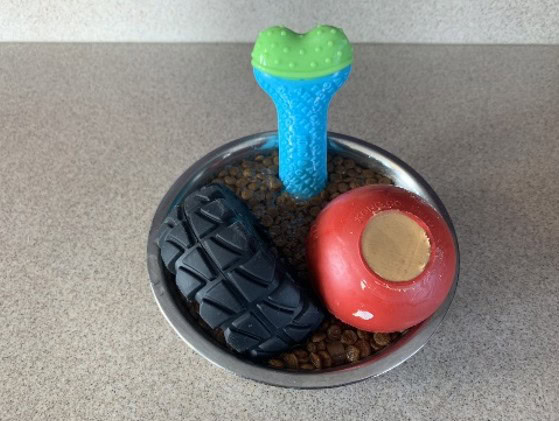
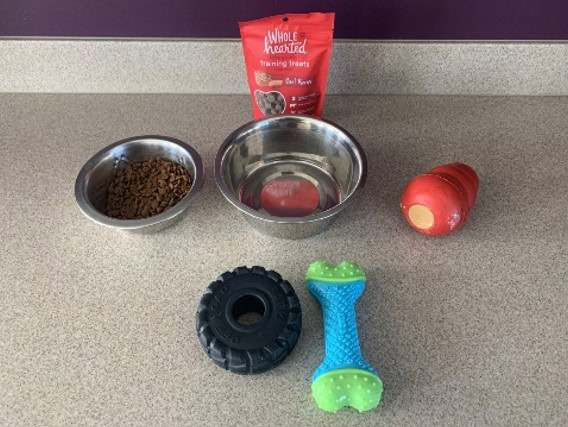
    Gather a few treats, some kibble, toys, a long-term chew or filled Kong, and a dog dish.  

    Kongs and toys in a bowl with frozen treats

    Step 2 

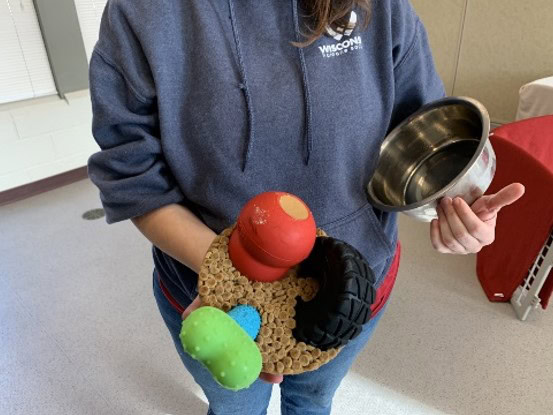
    Arrange the items and treats in the dish and fill the dish with water. Make sure the items stick out above the water level to capture your dog’s interest. Then stick it in the freezer!

    Person holding the frozen enrichment activity

    Step 3 

    Once frozen solid, remove from the bowl and give to your dog.  Remember, this item is messy as it thaws! This is a great activity to provide for your dog in the yard during comfortable weather, inside a larger walk-in shower stall, or on an easily cleaned floor.


    If your dog doesn’t seem interested, you can:

    • Experiment with different treats and toys
    • Try adjusting the size (a large dish may make the block too cumbersome for a small dog)
    • Try adding a little low-sodium, dog-safe broth to the water before freezing
  • Fourth of July Safety Tips

    Fourth of July Safety Tips

    For many families, the Fourth of July is an exciting day full of celebrations. Even if you do not personally take part in the festivities, you will likely hear the booming of fireworks and gatherings from nearby parks, festivals, or stadiums. While you may be easily able to tune it out, your dog may not feel as at ease. Many dogs find loud noises, flashing lights, and crowds of people very frightening; fireworks booming in the distance may increase their stress level and require additional support. It is important to set your dog up for a successful, stress-free, safe holiday. 

    While there are some dogs who will remain relaxed, calm, and not affected by loud noises, this is rare and should not be expected. When approaching the first holiday with your dog, use the guidance below and create a plan to set your dog up for success, regardless of how calm they seem to be on a daily basis.

    Do not bring your dog to firework displays

    Even if your dog tolerates crowds or even appears to enjoy events, leave them home for the firework shows. Fireworks are extremely loud, and with a dog’s heightened sense of hearing, they will be even louder. They also create a physical vibration and are a nearly impossible concept for dogs to grasp, leading to extreme stress and confusion when they can’t comprehend what the threat is or where it’s coming from. There is no benefit to testing your dog’s tolerance of fireworks, as this is not a necessary skill for everyday life. Avoid the risk of traumatizing your dog by leaving them home in a safe space. 

    Create a cozy retreat at home 

    There will be many times throughout your dog’s life where it will be helpful to confine them to a safe space where they can remain relaxed and comfortable away from activities. For example, if you are having work done on your home, hosting a large party, or when there are going to be loud fireworks. If you are hosting a Fourth of July gathering, there will likely be unsafe food dropped, people coming and going, and unpredictable events. If you do not already have a safe space for your dog, create one ahead of time so that your dog is familiar and completely relaxed in their zone. Choose a dog-proofed spare room away from the main traffic of the home. Ensure all windows and doors are securely closed, as a startled pet can easily push through screens. A crate can also be used if your dog is comfortable and relaxed while inside.

    Do not leave your dog in an outdoor enclosure or on a tie out. Even if your dog has an outdoor space that they use regularly, do not use it during fireworks. Some dogs become frantic when hearing loud noises and may hurt themselves trying to escape. Others will successfully escape an enclosure that usually contains them. Once loose, if the dog is frightened, they will likely run away attempting to get further and further from the noise. Instead, utilize an indoor safe space. The noise will also be slightly quieter inside with walls to block the sound. You can turn on a TV or radio, sound machine, and/or a fan to help mask the exterior noise. 

    There are some dogs whose behavior is not impacted negatively by fireworks and you will be able to go about your business normally that day. However, even the calmest dog should be kept indoors during fireworks for safety.  

    Staying with your animals 

    If you don’t plan to attend any festivities, you can either take your dog on a car ride to a quieter place or hunker down at home. Since fireworks are predictable and only happen on holidays, planning ahead and taking a drive away from the noise allows you to avoid the stress.  

    If choosing to stay home with your dog, providing them a safe space is still useful. Dogs who have been given a comforting spot to utilize throughout their life will seek it out in times of stress. You can help them settle by giving them a high-value enrichment item. If your home has a basement, take your dog downstairs with you, put on music or a movie, and settle in to wait out the noise. 

    Stress-relieving Products

    There are many products available to purchase that may benefit your dog when he or she is showing signs of stress. The impact of each product is individual to each dog and their level of stress. 

    • ThunderShirts are a tight-fitted “shirt” that provides gentle pressure across most of their body to reduce anxiety, like a swaddle for a baby. 
    • Pet-safe Diffusers plug in to your wall and provides a synthetic copy of a canine-appeasing pheromone and is a natural product proven to comfort both puppies and adult dogs. 
    • Soft Chew Calming Supplements are scientifically formulated to support relaxation calmness and composure for dogs with normal stress. As with any dietary supplement, please contact your veterinarian before beginning use. 
    • Find more products available in our Animal Antics online retail store! 100% of the proceeds benefits WHS.

    Microchips and ID tags

    Microchipping your pet is one of the most sure-fire ways to ensure they come back to you if they ever do get lost. This tiny, affordable chip can be implanted in mere seconds and is no more painful than a typical vaccine injection. The chip is not a tracking device but is merely loaded with your contact information. If your pet is ever found wandering alone, they’ll likely be brought to a veterinary office or an animal shelter where they will be scanned for a chip, providing your phone number so you can be quickly reached and reunited. 

    You’ll also want to make sure your pet’s ID tags are up to date and securely attached to their collar since this allows any finder to get them back home on their own. Some families use Daylight Savings as a biannual reminder to perform important home safety tasks, like testing smoke detectors – add your pet’s ID tag and microchip to the list so you can verify that you haven’t moved, changed phone numbers, or updated your email since the last check-in.

    Microchipping can occur during a routine visit to your vet’s office or at one of our low-cost clinics – book an appointment now!

    Professional Help 

    If your dog is showing signs of stress to the point of attempting to escape, shaking, drooling, pacing for a long period of time, or injuring themselves in any way,  contact your veterinarian and discuss the use of pharmaceuticals to help your dog handle the holiday. We also recommend working with a behavior professional one-on-one in conjunction with your vet to help support your dog. 

  • Escape Artists

    Escape Artists

    Does your dog routinely get loose, run off, or go missing? The outside world is full of trees to sniff, squirrels to chase, and other stimuli that many dogs find quite exciting. For certain dogs, these experiences are so alluring that the pup becomes highly motivated to get to them, regardless of any barriers that may be in place. They may try to dash out an open door, attempt to wriggle out of their collar while on leash, or escape fenced-in spaces. Each time they slip out or escape, all the fun they have becomes very reinforcing, only increasing the likelihood that they’ll do it again as soon as they get the chance. Although this behavior poses many safety concerns for the dog and is frustrating for you, they are not escaping because they dislike their home, to show “dominance,” or to spite their human. Dogs simply find the outside world highly reinforcing and are intrinsically motivated to get to what they find rewarding. 

    There are two steps to keeping an “escape artist” dog safe. First is managing their environment to eliminate their opportunities to escape, and second is teaching them new behaviors to practice instead. 

    Indoor Management

    If your dog is attempting to sneak out the door whenever it opens, or perhaps they even push through door or window screens, management is an important step to keeping your dog safe. Since life happens and no one is perfect, it’s necessary to have multiple strategies in place. It’s best to select two or more of the options below for your best chance at success. 

    • Closing Doors | If your home is set up for it, block access to external doors by closing interior doors. Place signs on the doors to remind all family members and visitors that these doors need to stay shut. Never open the external door without the dog on the opposite side of a second set of doors. 
    • Gates/Barriers | If you don’t have any interior doors to block exits, set up gates. There are many varieties of baby/pet gates for sale; it’s best to get one with vertical bars (instead of crosshatching which can be easily scaled by some dogs) that is tall enough so your dog cannot jump over it. Keeping your dog behind the barrier will allow you to enter and exit your home without giving them the chance to slip out. 
    • Leashes | Have your dog drag a leash while inside the home. This way, if your dog does attempt to slip out of the house, you will have something to grab as they exit. A leash is much easier to catch than a collar and won’t stress them out as much if you do need to grab it. 
    • Fencing | If you currently do not have a fenced-in yard and are unable to put up permanent fencing, consider placing temporary fencing outside around exit doors. It does not have to be a large area – it should just securely surround the door so they are enclosed if they do sneak out. By keeping this space small, it’s less desirable of a destination if they do get out, too. Snow fencing, zip ties, and some tall stakes work well for this. You can make a human “gate” by lifting one stake at the end of the fencing to open it up, walking out, and replacing the stake firmly behind you.

    Outdoor Management

    If your dog escapes your fenced-in yard while they’re outside, there are several strategies you can use. As with indoor management, we recommend using multiple techniques, since it gives you a backup safety net if another technique fails.

    • Supervise Your Dog | Even if your dog isn’t an escape artist, it is highly recommended that you supervise them whenever they are outside and never leave them unattended in the yard, regardless of the level of fencing. By supervising your dog outside, you will be able to redirect them away from the fence using high-value treats before they jump over it. It will be helpful to keep them engaged with something else to eliminate the temptation for them to leave. The goal is to make the yard more fun and rewarding than what lies outside of it. Having toys and treats on you while supervising will not only be a tool to redirect your dog away from the escape route, but it will also reinforce other good behaviors your dog shows while outside.
    • Fencing | If your dog can jump over or escape your fence, consider reinforcing your fence line. This could mean blocking a hole or adding chicken wire to make the space smaller between fence slats. You can also look into both commercial and homemade solutions for increasing the height of your fence, which may completely solve your problem. Another option is adding coyote rollers on the top. These prevent your dog from being able to climb the fence, as the top rail will roll, eliminating their ability to get traction and leap over. 
      Electric fences are not recommended and should not be used when considering how to reinforce your fence line. Many dogs are motivated enough to run through an electric fence and will tolerate the shock to get to whatever is on the other side. Then once your dog has gone through the fence, it will shock them again if they try and return home. Not only is it unsafe if your dog chooses to run out of the yard through the electric fence, but it also will be actively punishing them if they attempt to return home. 
    • Longline | Have your dog drag a longline while outside. A longline is an extra-long, lightweight leash that typically ranges from 15 to 30 feet or longer. You can purchase them or make your on by picking up a clip and long rope from the hardware store (clothesline rope is a great thickness) and securely attaching the two. This will allow you to easily stop your dog if they begin to head to the fence to make a leap for freedom, even if you are across the yard. If the dog makes it over the fence, the longline will be long enough for you to grab before they are off on their self-guided adventure. If you need to use the longline, be sure to reinforce your dog with high-value treats when maneuvering them away from the fence. Even if you are frustrated that they made an escape attempt, it is important to always reward them for coming back to you (even with a longline assist). This will build up their reinforcement history with you and make them more likely to come when called. 

    Visitor Management

    Another part of management is preparing all visitors on how to enter your home. It is important to prewire how you would like your visitors to notify you that they have arrived, as well as where and how they should enter. Good friends may have previously walked right into your home without announcing their arrival, but this could be dangerous for your dog and detrimental to your training. Since this may be a change for many of your regular visitors, polite but clear signs on your doors can be a useful tool to help remind visitors of what to do. Signs will also be helpful for unexpected visitors who you weren’t able to prewire instructions to. 

    Training

    If your dog doesn’t already reliably know any cues, it will be helpful to work on the basics first while your management (gates, doors, temporary fencing, etc.) is in place. Practice lots with high-value treats until they are highly motivated to perform it for you. The cue itself doesn’t matter – it could be sit, down, roll over, high five, etc. – the goal is for this cue to have so much reinforcement behind it that your dog responds to it almost reflexively. Once you and your pup have mastered this cue, it will allow you to interrupt your dog if they are attempting to escape. Having the dog stop in their tracks will give you time to pick up the leash, shut a door, put up a gate, etc. This should only be used in an emergency, as the cue could lose value over time if used repeatedly in this situation. We recommend attending training classes to learn more about teaching your dog different cues and building up their skillset. You can learn about the options offered at WHS by visiting www.wihumane.org/behavior

    There are also several specific behaviors that you can begin working on that will help support your management techniques and reduce your dog’s escape attempts. 

    • Go to a mat | You can reduce the likelihood of your dog slipping out the door by teaching them to go to a mat (or any specific location) when people enter your home or if they hear the doorbell ring. If they are lying on a mat snacking on some treats, they can’t simultaneously be running out the door. To create this behavior, you will be pairing the doorbell or knock with food on your dog’s mat. The ring of the doorbell or knock will become the cue for your dog to lie down on their mat. This will take time and patience, as well as lots of extra delicious treats and tons of repetition. Remember, you’ve got to make the mat more rewarding than all the exciting things outside.
    • Come | Teaching your dog a reliable recall cue will be another safeguard for when other management techniques fail. If your dog is heading to the door and other barriers are not in place, having a reliable “come” cue will increase the likelihood that they will turn and come back to you before making their escape. See our resource on Coming When Called for a guide on how to teach this cue.
    • Wait at the door | Although this should not replace other tools, having your dog wait at doorways before exiting is another good backup for dogs who previously dashed out of the door. You can visit Dog Training by Kikopup on YouTube to find her video titled “Door Manners for Dogs” for great tips.