
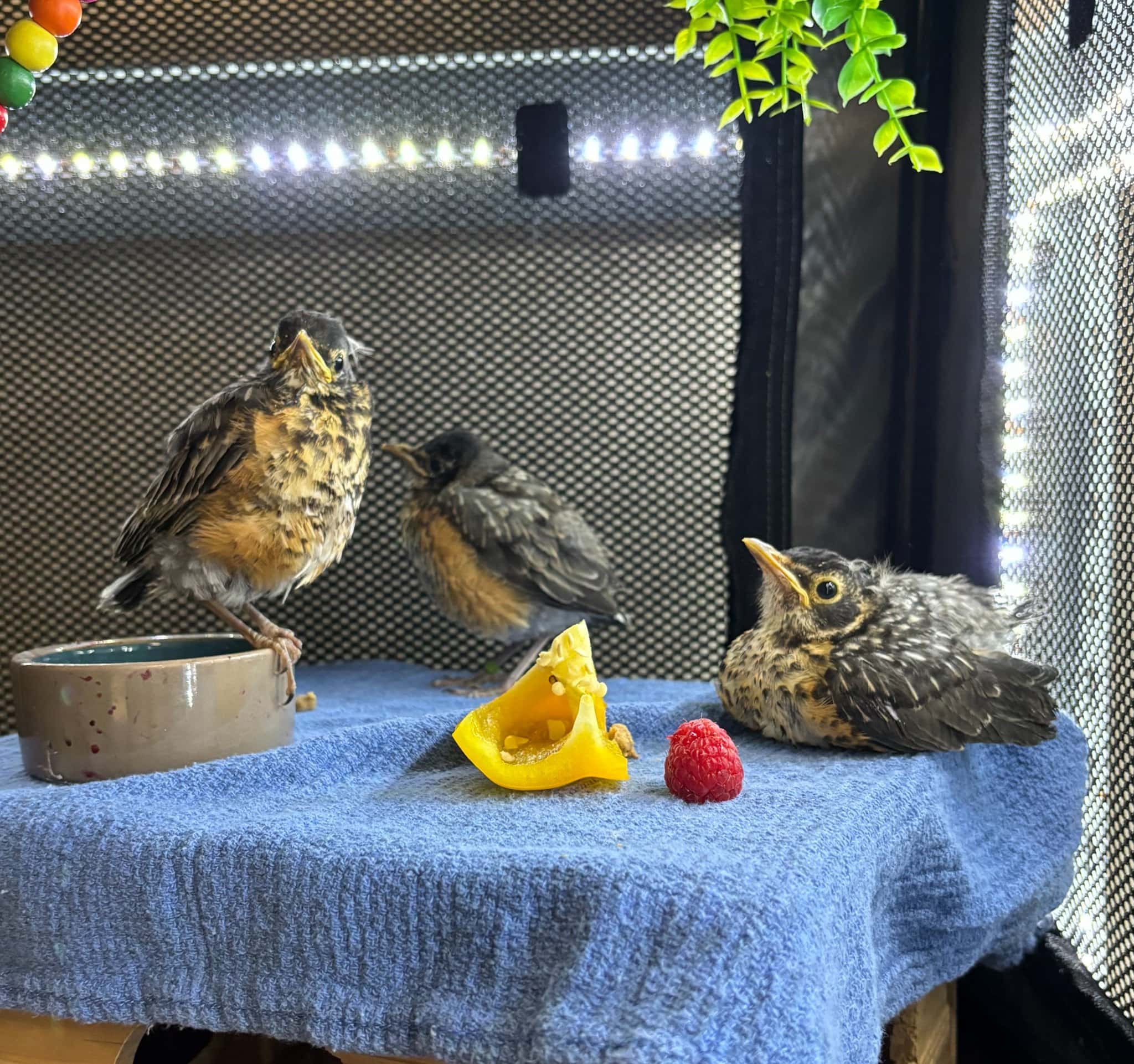
We care for more than 150 different species of animals, including all species of native birds, reptiles, and amphibians, as well as most mammals.
We do not rehabilitate non-native birds (house sparrows, European starlings, rock pigeons, mute swans). We are also prohibited from rehabilitating bears, skunks, Norway rats, or white-tailed deer in our facility, per DNR restrictions. If you have found an animal that we do not rehabilitate, please call the Wisconsin Department of Natural Resources (DNR) Hotline at (608) 267-0866 (Monday-Friday) or the DNR Call Center at (888) 936-7463 (weekends) for a referral or advice regarding next steps. You can also consult their rehab directory by species: https://dnr.wisconsin.gov/topic/WildlifeHabitat/directory. Note that we may be able to accept these animals for humane euthanasia if it is in the best interest of the patient.
Our wildlife hospital is located in Milwaukee and we are able to admit patients by appointment from Milwaukee, Racine, and Ozaukee Counties. If you are outside of our admission area, please review this list of licensed wildlife rehabilitators in Wisconsin. If you are outsite the state of Wisconsin, click here.
This restriction is due to limited resources and space, as well as patient stress – transporting a wild animal over long distances can be stressful and detrimental to that animal, so we will always refer you to a closer wildlife rehabilitator or specialist depending on the species and/or location where you found the animal. We also have regulations through our wildlife rehabilitation licensing with the Wisconsin Department of Natural Resources we must follow related to certain species and locations where we can and cannot admit patients from.
With hundreds of animals in treatment, patient care is our top priority, so we only give updates upon request. We are unable to provide updates during our peak season (spring and summer), but if you’d like to hear from us in the fall or winter when we have more resources, please submit a message here.
We greatly appreciate your patience!
As a rule, wild animals are afraid of humans, so being in close proximity to humans is very stressful for them. All of the wild animal patients at our facility are injured, sick, or orphaned and thus have an even greater need for an environment that is as stress-free as possible to aid in their recuperation. For these reasons, state and federal laws prohibit putting animals being held for rehabilitation on public display.
No. To protect wildlife and human health and safety, state and/or federal laws forbid the keeping of wild animals as pets. Wild animals may carry diseases and parasites, some of them serious and even potentially deadly, which could be transmitted to humans when the animals are kept in captivity.
It is also a bad idea for several other reasons. While cute and relatively easy to handle when they are young, they nearly always become unmanageable and may even bite or otherwise injure their handlers when they get older. Furthermore, once habituated to humans by excessive handling and association of humans with food and other comforts, if released, these young wild animals are often unable to adapt to life in the wild, and this habituation is not always reversible. Adult wild animals are typically fearful of humans and are used to roaming free, and would be very stressed if people attempted to keep them as pets.
We care deeply about the animals brought to us for care and wish that each and every one could be rehabilitated and released again to the wild. But sometimes their injuries or illnesses are so debilitating it prevents them from being able to survive on their own in the wild. For a few of these animals, we can find permanent placement for them with properly permitted and licensed educational organizations that have appropriate housing and experience to provide a high quality of life. If a high quality of life in permanent placement is not an option for a non-releasable patient, in the best interest of the wild animal, ethically and legally, we euthanize them in a humane, painless manner to prevent further suffering.
As hard as we try, not all patients survive rehabilitative care. For patients who have died in care or were humanely euthanized, most are cremated onsite. Unless you are permitted by the state and/or federal government (depending on species), it is generally illegal for us to return a deceased animal to you. Additionally, any patient that was humanely euthanized contains controlled substances that need to be disposed of properly by law.
For a few avian species of religious significance to tribal members that are protected by the Migratory Bird Treaty Act of 1918, we do send the remains of those patients to the Liberty Wildlife Non-eagle Feather Repository for distribution to enrolled members of federally recognized tribes. With the permits we have, by law, we are unable to directly transfer feathers to tribal members. Legal feather access for tribal members is important to WHS as we view sending feathers to the repository as an extension of the dedicated care our staff and volunteers have for the thousands of birds we work to save. It aligns with our mission to make a difference for animals and the people who love them.
Our primary focus as a medical center is to treat sick, injured, and orphaned wildlife, and to be a resource center for those needing assistance with local wildlife. We have very limited capacity to provide off-site programs. You can find our bird-safe classroom materials here.
We rely heavily on volunteers to help keep our wildlife hospital functioning! Volunteers help in so many ways – cleaning cages, preparing patient diets, helping at our front desk and on the phones, assisting with rescues and releases, and so much more! CLICK HERE to learn more and get started!
The Wisconsin Humane Society is a private, non-profit organization. We do not receive any general government funding and are not affiliated with, nor financially supported by, the Wisconsin DNR, the U.S. Fish and Wildlife Service, the Milwaukee County Zoo, or any governmental agency. Your tax dollars do not go toward supporting the WHS Wildlife Rehabilitation Center. We are funded through the generous support of community-minded companies, foundations, and caring individuals. To make a gift today, CLICK HERE. Thank you for your support!
We rely on both in-kind and monetary donations to help us provide lifesaving care for thousands of wild animals every year.
– To check out our Wish List of in-kind items, click here
– To make a donation online, click here
Thank you for your support!
No. We do not advocate for utilizing live-traps as a response to a human-wildlife conflict and strongly advise humane exclusion as a long-term solution. Live-trapping does not provide a long-term solution to a nuisance problem. See more information here.
For advice on humane exclusion options, give us a call at 414-431-6204 during open hours or CLICK HERE.
Our live traps are used only for rescuing animals in situations where they are trapped and cannot get out another way (e.g. in a basement with windows that do not open), or to capture an animal with an injury or illness that needs treatment.
Becoming a licensed wildlife rehabilitator is a heavily regulated and advanced medical field. To start, we recommend reviewing the National Wildlife Rehabilitators Assocation’s page for aspiring wildlife rehabilitators here. In the state of Wisconsin, to become a licensed wildlife rehabilitator you will need to obtain state licensing through the Wisconsin Department of Natural Resources. If you want to work with any native bird species, federal permits are required from the U.S. Fish and Wildlife Service as well.