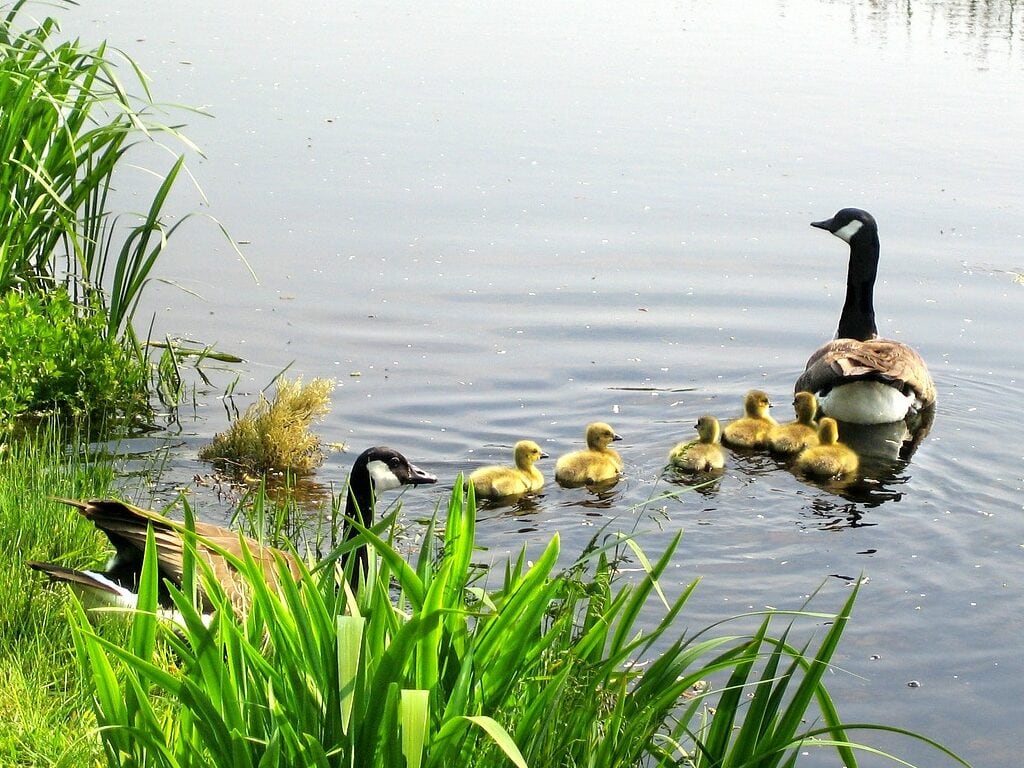
Once thought to be extinct, the non-migratory “Giant” race of Canada Geese was “rediscovered” in small numbers a few decades ago and thereafter transplanted widely across the US. Generations of their offspring have adapted to living happily in suburban and even urban habitats, grazing on the lush green lawns and swimming in the shallow ponds often found in these areas. But with their resurgence has come some challenges for the humans who find them in their shared spaces.
Geese can leave abundant droppings, creating problems for parks, golf courses, and athletic fields. Their presence in large concentrations can also lead to shoreline erosion, habitat degradation, and water quality issues. Furthermore, geese can be very defensive when nesting and can become a potentially hazardous nuisance to humans when they nest in close proximity.
FAQs & Humane Solutions:
“Is it OK if I feed the geese in the park?”
Feeding the geese encourages them to remain and concentrate in areas where their presence may be creating problems. This also makes them more prone to spreading diseases amongst themselves, to other wildlife, and even to humans. The geese generally don’t need handouts from people to survive. They have adapted to grazing on lush vegetation, such as grasses, and the large amounts of bread, corn, and similar foods people usually offer are of questionable nutritional value for the geese.
In an attempt to control nuisance problems caused by geese, some municipalities, parks, and neighborhood associations have established ordinances or rules that forbid people from feeding geese. So if you insist on feeding, it’s a good idea to check your local ordinances and site-specific rules before you do so.
“How do I reduce the amount of goose droppings in my yard?”
There are a number of ways you can go about humanely resolving problems involving Canada geese. There is no one method that works in every situation. Utilizing a combination of approaches should help boost the success of your problem-solving efforts.
Altering habitat is considered the most effective long-term approach to discouraging geese from an area. Methods include:
- Visual barriers – For grazing, geese prefer a large, unobstructed lawn in close proximity to open water. Bushes and shrubs provide cover for predators to hide and limit visibility for geese, and this makes them feel uncomfortable. So planting bushes or even a hedge, adding large rocks, a wall or fence, or other obstacles to visibility can cause geese to avoid an area.
- Less palatable plants – Young grass shoots, particularly of finer-bladed varieties such as Kentucky bluegrass, are preferred fare for geese. Less palatable plants such as native grasses and wildflowers, or tall fescue, common periwinkle, or English Ivy could eventually be substituted, if possible. If changing the composition of the lawn is not possible, you can make your lawn less “tasty” for the geese by watering less or not at all, reducing or eliminating the use of fertilizer, and allowing the grass to grow taller.
- Exclusion means introducing barriers, whether physical (like an actual multi-wire or wooden fence) or visual (something that doesn’t physically prevent the geese from entering an area but which the geese do not want to cross).
- Fences can deter geese from walking into an area. They need to be at least 30 inches tall and have no openings larger than 3 inches. Chicken wire, picket fencing, plastic mesh, mylar ribbon strips, and plastic snow fencing are examples of effective materials. Even simple barrier fences made by tying multiple strings spaced a few inches apart to vertical uprights, which are spaced no more than about 20 feet apart, can be effective. Fences are most effective if erected in early spring before nesting occurs or in early summer when geese have young and are molting their flight feathers and are unable to fly over the fence. Fencing is generally not effective in keeping geese off of large areas when they are flight-capable, because they can simply fly over the fence.
- Repellents are chemicals designed to deter an animal from eating a particular food or from entering or living in a designated area. For discouraging geese, methyl anthranilate is a non-toxic, biodegradable human food ingredient that can serve as a taste-repellent when applied to grass. It is marketed under various brand names, one being Liquid Fence Goose Repellent®. These products are applied by spraying them on the lawn using the dilutions recommended by the manufacturer. The products should be reapplied every 7-14 days, after a rain, and after each lawn mowing.
- Scare Tactics are non-chemical devices or activities designed to arouse fear or alarm to deter an animal from entering or lingering in a particular area.
They include noisemaking devices such as the Goose B-Gone Super Sonic®, sirens, electronic whistles, etc.); visual deterrents such as Irri-tape® mylar tape, strobe lights, Scare Eye® balloons, coyote effigies, etc.; and devices that scare by other means such as the Scarecrow® motion-activated sprayer which frightens birds entering its sensor area by blasting them with a harmless blast of water. Then there’s the old-fashioned method of simply going out and making noise by banging on pots or pans, yelling, and waving your arms as you approach the geese. - Hire Help: If you are unwilling to tolerate or unable to haze the geese yourself, there is the option to hire a humane animal removal company to do the work for you. Click here for more information on choosing the right company for the job.
“What’s the best way to handle geese near shorelines or other water sources?”
In addition to the methods discussed directly above, there are some other actions you can take that may prove useful:
Shorelines – Geese prefer to walk, rather than fly, from land into water and vice versa. And they prefer to do so where the shoreline is gently sloped. They do not like to walk over rocks, nor do they like to have to push their way through dense shoreline vegetation to get in and out of the water. So to discourage geese from feeding on areas of grass near the water, to discourage them from using a particular portion of shoreline for entry and exit from the water, and to help stabilize the shoreline from erosion, a band of “riprap” (chunks of stone rubble) can be added to the shore at the waterline.
Planting or encouraging emergent vegetation (growing out of the water, e.g., cattails) close to the shoreline and tall grasses or shrubs in a wide band along the edge of the shoreline will help prevent erosion and create a physical and visual barrier that the geese should not want to cross. Aesthetically, these offer the best solution; however, constructing a three-foot-high fence between the shoreline and adjacent lawn areas will also discourage geese.
Aerators – Consider shutting off pond aerators in the late fall. This should help the pond ice over earlier, and without open water, the geese will be encouraged to move elsewhere.
Discourage Feeding – Goose feeding done by residents or visitors can help attract and retain geese at your location, so it should be discouraged.
“What is egg addling? Is it humane?”
Egg addling is a humane technique used to limit the reproduction of Canada geese. Addling involves locating goose nests in the early spring, very soon after the goose has started incubating the eggs, dipping each egg found in corn oil, and replacing them in the nest. The coating of oil on the egg stops the transfer of oxygen through the shell and thus stops further development of the barely-developed embryos. The dipped eggs are left in the nest for about two weeks. The goose will continue to incubate the eggs during that time. After two weeks, workers remove the now non-viable eggs from the nest. Because the goose has had two weeks on her nest, this satisfies her urge to nest, so she will not attempt to re-nest again that year. Without the two weeks on the nest, she would likely just start nesting all over again.
Addling requires a permit from the Wisconsin DNR and should be employed only by those trained in its proper use, in combination with other goose management tools such as habitat modification, and only when non-lethal methods have been tried and shown to be less than fully effective.
“There is a goose attacking people who pass by my home or business. What can I do?”
Canada Geese in urban areas will often choose nest sites in what seem to us humans to be less-than-ideal places, such as landscaped medians in parking lots, flat roof tops, and planters or landscape shrubbery on bridges or next to busy sidewalks. Of course, understandably, protecting one’s nest and offspring is a very basic instinct, and both parents will be very protective of the nest and eggs, and their goslings.
A goose will lay one egg about every day-and-a-half and may lay up to 15 eggs (10 to 12 is more common). Once she is done laying all her eggs, she will then begin to incubate them together for about 30 days. So the longest the pair will be at the nest site is about 45 days. Once the eggs have hatched, the parents will walk their family to a nearby (but may be up to 2 miles away!) body of water, and they won’t return to the nest.
We typically get several calls each spring from people who are having problems with a defensive male goose accosting people who are unknowingly passing near its nest site. In these cases the male goose’s strategy is to try to scare the “intruder” away by spreading his wings, hissing and running or sometimes flying toward the person. The goose doesn’t usually make contact with the person, but there are exceptions, and there is the potential for someone to get hurt.
Solutions:
- Prevention
Before the geese have laid eggs, you can encourage them to move along and nest somewhere else by treating the grass around the nest area with a goose repellent (see “Repellents” above). You can also use exclusion techniques (see “Exclusion” above) to deny the geese access to planters or other areas they have previously used or appear to be preparing to use for nesting. - Construct a barrier
Use at least a 4-foot-tall temporary fencing material, such as snow fence or plastic barricade fencing, between the sidewalk and the goose nest. This barrier should help give both the geese and people greater security. Keep in mind that fencing must not prevent the parents from getting to and from the nest, and must not prevent the goslings from leaving the nest area. - Signage
Put up signs to warn pedestrians that there is a goose nest and protective parents ahead. Suggest options for other routes they can take so they avoid the geese. - Alternate Route
Temporarily close the sidewalk that passes through the problem area. Direct customers to an alternate entry to your building. - Nest Removal?
Canada geese are a protected species; once they have a nest with eggs, you cannot legally disrupt or move the geese or their nest without a special permit. Even if it were legal, geese are very unlikely to continue to incubate their eggs if they are relocated. If you are convinced that removing the nest or geese is the only way to protect human safety in your situation, contact the Wisconsin Department of Natural Resources.
“What should I do if geese have nested in what looks like a dangerous location?”
This has become very common in the Greater Milwaukee area in the last few decades. In more rural areas, geese will typically nest on raised muskrat houses in a marsh, or on an island or peninsula in a river, lake, or pond. Apparently, parking lot “islands” and raised planters in business and residential areas have enough similarities to attract urban geese to these unseemly nest sites.
Solutions:
- Prevention
Prior to nesting, exclude (see “Exclusion” above) geese from using these locations, especially if they’ve used them in the past and you want to prevent them from using a location again. - Move the Nest?
Canada geese are a protected species; once they have a nest with eggs, you cannot legally disrupt or move the geese or their nest without a special permit. Even if it were legal, geese are very unlikely to continue to incubate their eggs if they are relocated. - Signage
You may want to erect barricades and signs to keep traffic and pedestrians away from the nest area. - Escort
Soon after the eggs have all hatched, the parent geese will attempt to lead their goslings from the nest site to whatever body of water they’ve decided upon as a destination. The local police and/or lot security may be able to give the goose family an escort across the parking lot to a safe place. The escort can help keep the geese safe during their passage and will likely also help keep motorists safer, as well. The escorts may need to slowly and quietly guide the goose family around obstacles and hazards on their trip.
Your local, licensed wildlife rehabilitator may also be able to help. In Milwaukee County, you are welcome to call us at (414) 431-6204.