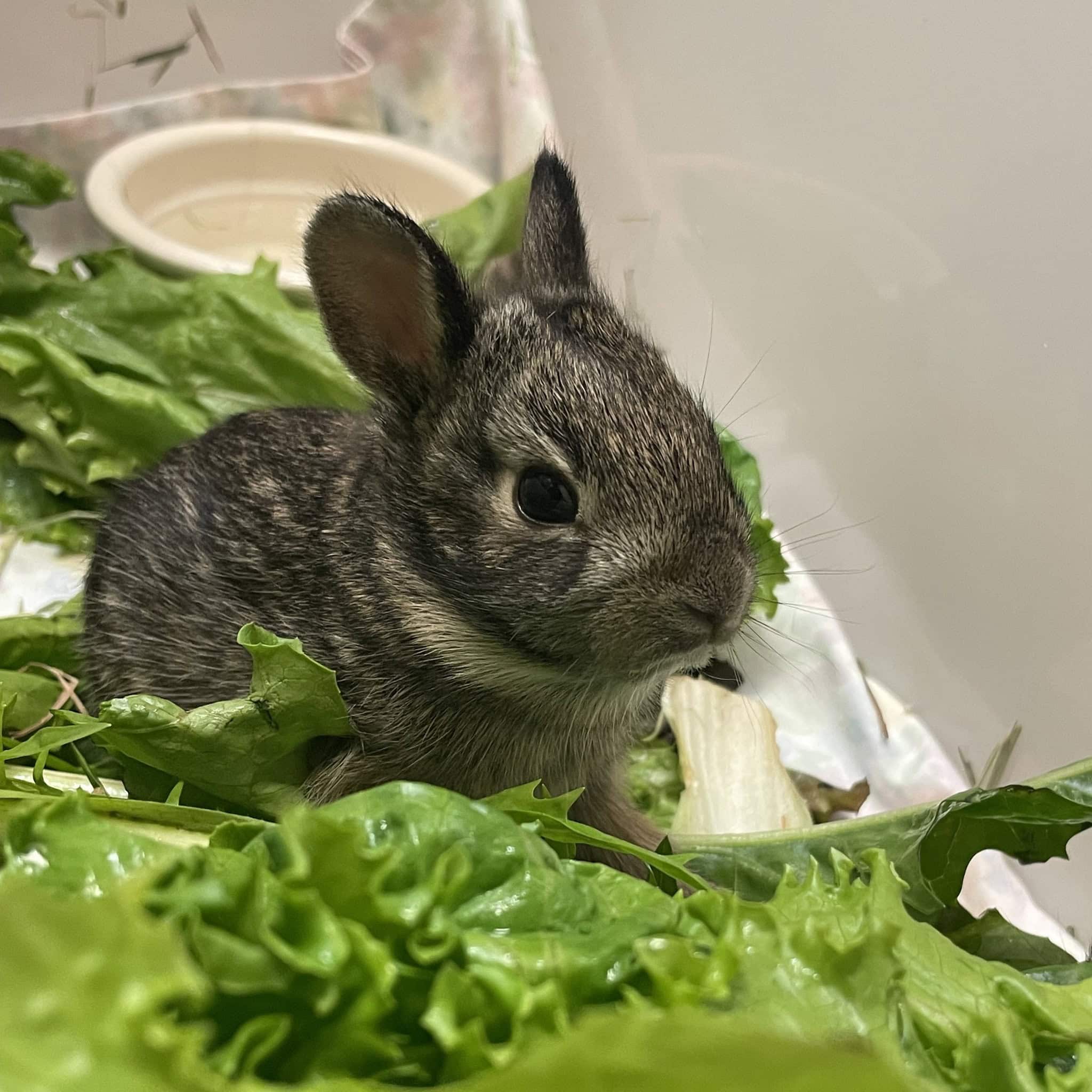
Cottontails typically scrape out a shallow “pocket” in the soil for their nest. After giving birth, the mom rabbit covers her babies with some of her own fur and often some vegetation, such as dried grasses. The nest may be just about anywhere the mother can dig in the soil: in lawns, gardens, planters, under landscape shrubbery, on playgrounds, athletic fields, etc.
To avoid attracting attention to her nest, the mother rabbit typically only visits the nest to feed her young at dawn and dusk. She will continue to nurse her young in the nest for about four weeks. By this time, the young bunnies will have already begun adventuring out of the nest to nibble nearby greenery. Surprisingly, the young rabbits become independent of their mother at about four to five weeks of age. At this time, they are only four to five inches long.
Here are a few important tips to know:
- Mother rabbits visit their babies only twice a day – typically around dawn and dusk – to avoid attracting unwanted attention from predators in the area. Most seemingly “abandoned” babies are actually being watched closely by mom from a distance.
- If you find a rabbit’s nest in your yard and the babies are not injured, there’s a good chance they can stay there. No one can do a better job than mom, and there is no human-made formula that is nearly as good as what she provides. The only time a wildlife rehabilitator needs to get involved is if those babies are injured or truly orphaned. Mothers will continue to nurse their young in the nest for about four weeks. By this time, the young bunnies will have already begun adventuring out of the nest to nibble on nearby greenery. Young rabbits become independent of their mother at about four to five weeks of age, when they are only four to five inches long.
- While you should do everything you can to avoid touching a bunny at all, much less with bare hands, a mother will not reject her babies just because they have been touched by humans. If someone has already picked up a baby bunny and the baby appears healthy, please ask them to return the little one to the nest.
FAQs & Solutions
No. The mother rabbit will not recognize the nest as her own if you relocate it, and the babies will be abandoned. Instead of relocating the nest, simply mark the location so you can mow around it until the babies leave the nest. Instruct children not to disturb the nest. Keep your pets away from the nest and use another pet exercise area for the few weeks it takes for the young bunnies to become mobile and leave the immediate area.
If you find a young Cottontail who appears weak, injured, listless, or ill, she may need to go to your local wildlife rehabilitator for an exam and treatment. If the rabbit was found in Milwaukee County, you may call us at 414-431-6204 for further advice.
If you are concerned that crows, cats, dogs, or children will harm the babies in the nest, you can try placing an empty, upside-down laundry basket over the nest during the daytime (see photos in the PDF linked at the top of this page). You should weigh the basket down by placing a brick or other reasonably heavy object on top of the basket. The basket must be removed around dusk and left off all night so the mom rabbit can get to her nest to feed her young.
Because the mother rabbit typically only visits her nest at dawn and dusk, people very often assume that because they haven’t seen the mother at the nest, the young have been abandoned. To find out if a mom rabbit is still caring for her young, you can do “the Twig Test” (see photos in the PDF linked at the top of this page).
To do the Twig Test, place twigs or pieces of string in a criss-crossed, checkerboard pattern spaced 1-2″ apart, over the nest in the afternoon or early evening. Check the nest the following morning. If the twigs have been disturbed, the mother is probably caring for the babies. If the twigs do not appear to have been disturbed, the babies may be orphaned. It is sometimes possible for the mom to feed her babies without appreciably disturbing the twigs. We know this because we have had people bring in baby Cottontails from nests after they tried the Twig Test; they thought that the twigs had not been moved and thus the mom rabbit wasn’t returning, but the babies’ bellies were full of milk!
In any case, do not try to feed or handle the babies until you speak to your local licensed wildlife rehabilitator. If you live in Milwaukee County, call us at (414) 431-6204 for further assistance. If there is evidence that the babies may be orphaned, like a failed Twig Test, we may suggest that you bring in the nestlings so we can do a “belly-check” to see if they are actually still being cared for. If they have milk in their bellies, we’ll have you take them back and replace them carefully in their nest.
If you have run over a nest with a lawn mower, roto-tiller, weed trimmer, or other device, check all babies for injuries. But before inspecting the babies, we suggest that you put on plastic exam gloves or plastic bags on your hands to protect yourself from contact with rabbit blood, urine, or feces. The chances of you getting sick from this contact are very small, but it’s better to be safe than sorry.
Uninjured babies should be placed back in the nest and the nest re-covered with the original covering material. Injured bunnies should be transported to your local licensed wildlife rehabilitator in a paper-towel-lined, covered box with small holes for ventilation. Wash your hands with soap and water after handling the rabbits or their nest material.
If your child brings home a young Cottontail, call a local licensed wildlife rehabilitator immediately for advice. Ask your child if he or she knows the location of the rabbit’s nest. If they do, and the rabbit is still at the nestling stage, the rabbit should be returned to its nest. If it is past the nestling stage (at least 4″ long and its eyes are open), the bunny should be returned as close as possible to where it was found, assuming that it was not in imminent danger when found. The mother will NOT reject her babies simply because they have been touched by humans.
We understand the temptation to care for such adorable little creatures, but please do not ever feed or attempt to raise any wild animal. You’re likely to do more harm than good. Follow the advice above for reuniting the bunny with its mother and siblings. If you are unable to return a nestling-age rabbit to its nest, call a local licensed wildlife rehabilitator for advice. Cottontails have very special dietary needs. Improper feeding will cause serious illness or death. Also, it is illegal in Wisconsin and many other states to keep most species of wild animals as pets. Furthermore, the tame animal will not be able to survive long-term if it is ever released. It is important to know that wild animals very often have parasites and sometimes have bacteria, viruses, or fungi that could make you, a member of your family, or a pet sick.
If a young rabbit is found in a window well and appears to be healthy, active, and uninjured, remove her from the window well and place her several feet away from the well, preferably under some bushes or other protective cover. Be sure to cover the window well so she or other wild animals cannot fall into it. If she is lying on her side, has flies or ants on her, or she appears to be injured or sick, please call a local licensed wildlife rehabilitator for advice.